Friday, April 12, 2019

Blogging in 2019: Marketing Benefits and Best Practices
In an image-driven world, visualization is still a hot topic, especially in marketing. The hype around video content is still alive and well, and blogging is everything but over.
If you’re planning on starting your own business or stepping up your business game, your content strategy should still involve blogging, as there are great marketing benefits of it.
Featuring a blog as part of your website significantly increases your chances of being ranked higher in search engines.
Also, businesses that use blogging in their content marketing campaigns have increased chances of generating more leads than those who don’t. There are dozens of good reasons why blogging is important:
- It’s an essential content marketing tactic.
- Blogs provide in-depth material that is engaging.
- People trust blogs.
- It allow businesses to develop a unique brand voice and stand out from the crowd.
- Blogging drives traffic to sites and is excellent for SEO campaigns.
- Blogs provide inbound links that give sites a higher rank in search engines.
- Blogging is cost-effective and gets results.
- Blogs allow businesses to get in touch with their consumers.
- Blogging is essential for a strong social media presence.
- It’s better than advertising.
With all this in mind, let’s go through some of the most important marketing benefits of blogging, as well as what the best blogging practices are in 2019.
Marketing benefits of blogging
Blogging is an excellent inbound technique that helps every online business create value for its consumer base and sell their products more effectively.
Now, business blogging has to be all about quality, usefulness, and relevance. These three things give any online business authority in their niche by posting in-depth content that will capture the right audience by providing specific solutions to specific problems.
If we take all these facts into consideration, we can safely say that the most important marketing benefits of blogging are:
- Industry expertise
- SEO & more traffic
- Exposure
- Subscriptions
- Lead generation
- Backlinks
Industry expertise
As a business owner, you want to show your audience that you are an expert in your industry. The main benefit you get from this is trust. The best way to do this is by sharing high-quality, industry-relevant knowledge with your customer base.
That means that you need to be consistent in publishing in-depth content. In return, you build confidence with the customers that will result in their trust. A loyal customer is the best customer, and it’s much easier to sell if they trust your brand.
SEO & traffic
The main benefit of search engine optimization is higher ranking in search engine results. But, SEO is much more than just that. It’s a tactic that works best in the long run. SEO makes your brand visible and it helps you stand out from the crowd.
Writing blogs around the most frequently used and popular keywords when publishing relevant content is the best way to increase online visibility. Higher ranking means more online users seeing your blog.
On top of all that, blogging also requires using online tools to increase online visibility in searches even more. It’s a fantastic way to drive more traffic to your website.
A lot of recent studies have shown that most online users don’t go beyond the first page of search results. So, if your brand doesn’t show up on page one of Google, it’s like you don’t exist. If you use SEO to your advantage, you get higher ranking and increased visibility, which allows you to feature more prominently in search engine results.
The higher the ranking, the more traffic you drive to your website. People use the most popular keywords to find what they need, so blogging and keeping SEO in mind helps you be the first to answer their questions and solve their problems.
Also, if you need help writing SEO-friendly content we’re here for you ;).
Exposure
Building brand awareness is an excellent way to stay competitive by staying relevant. Instead of investing in promoting your brand, building awareness allows it to promote itself.
Every brand needs online exposure to increase its visibility and a blog can provide it by sharing valuable knowledge.
It’s not only about selling and revenue, it’s also about catering to the needs of your customers and educating them further about your industry, niche, brand, products, services, and so on.
It’s about adding value and spreading awareness about new features and products.

Subscriptions
Subscriptions are a great way for any brand to engage with their customers and get to know their preferences and habits.
Blogging helps businesses collect emails – asking people to subscribe to a blog they find helpful is much easier than trying to get them to subscribe for email updates as soon as they land on the homepage.
All these subscriptions are an excellent way to add more users to your marketing funnel to improve brand-customer communication, offer products that might interest your audience, promote new products, and so on.
Lead generation
When a business builds a list of potential customers, they can use these subscriptions to improve their lead generation. Communication allows a brand to convert potential customers into loyal consumers.
That’s why most brands use such a contact form to capture those potential customers. Once a brand generates enough demand, they can sell easier, but it’s also a great way to cultivate interest in their products.
Backlinks
One of the greatest SEO growth tools is generating inbound or backlinks. These are links on other web pages relevant to your business niche that link back to your website. Backlinks create even more value for customers and also help online businesses remain relevant in search engine results.
Be sure to check out the most effective tactics to earn high-quality links.
Best practices in blogging
Now that we’ve pointed out some of the most important marketing benefits of blogging, let’s review the best blogging practices to get those very benefits.
Create a content calendar
A content calendar helps business get organized throughout the entire year. This helps brands be more productive, stay consistent, and always have the most relevant content prepared.
Use a content calendar to show the right information to the right audience and at the right moment. This way you’ll avoid cluttering your blog with loads of chaotic information.
There are many online tools that may help you and your team plan all the posts in advance and stay on schedule.
Provide value
Consistent content generation helps an online business create value.
And when a brand consistently provides value, it helps them grow and expand their customer base, increase lead generation and conversion rates and generate more revenue.
Blogging is the best way to do this, as you can post in-depth and original pieces, that can’t be found anywhere else, as many times as you find suitable, even with little budget.
I’m sure people will appreciate you being a knowledge compendium on everything they need to know about your niche.
Make it visual
Blogs help brands find their voice by exploring issues and concerns of their audiences. Brands can capture the attention of their customers by providing exactly what their audience needs. This is where visualization plays an important part.
Content greatly matters but content alone isn’t enough to make the best impression. So, making it visual allows the customers to not only read about the business but also see it.
If you give examples, try to add a couple of screenshots and photos (always give credit, btw.). If you’re trying to illustrate something or give instructions, you can make infographics, GIFs or even videos, and embed them in your blogpost.
Images can also bring lots of traffic to your website – you just need to know a few trick, so be sure to check out 6 Tricks for Getting Traffic to Your Blog from Image Search.
GetResponse likes to show visual examples of good marketing automation workflows on the blog. Why? Because it familiarises the user with the product, gives visual inspiration and shows that it’s easy to use.

Keep the content quality consistent
If the quality of your content is consistent, it helps potential customers and online users trust your business.
Publishing quality content means establishing authority in your line of work.
On top of all that, quality, fresh and unique content ranks well on Google, so you do the math.
Do all the needed research before you make statements on your blog. Write on subjects that matter, even if it matters to a teeny-tiny segment of your target audience. Enrich the content in any way you seem fit.
Also, it’s not a good practice to publish clickbaits – it makes you untrustworthy and lowers your blog’s quality.
And, remember to proofread your content before you hit “publish” to avoid any funny or business-threatening mishaps.
Engage with users
Modern online users love personalization. Customers are more likely to buy from the brands that engage with them and listen to them. One of the best ways to this is by asking for feedback.
Customers can use blogs to leave comments and impressions, which is an excellent way to engage with them even more. Some companies adjust their marketing strategies according to the engagement they get.
So, encourage your readers to comment on your content, say what they like and dislike, ask questions, and tell you what they’d like to see in the future. Then, reply to as many of them as you can to make the audience feel seen. They’ll know there’s a real person behind the blog that cares about their community and they’ll visit you and engage with you even more.
Promote your content
Since blogs help brands promote their content, blogging is an excellent way to stay ahead of the competition. Every brand that actively promotes their content in an interesting and consistent way encourages its customers to buy more. Blogging is all about the content promotion so by putting the two together, brands can reap significant benefits.
Share the posts you publish on social media and send content updates to your subscribers once in a while ;).
Allow guest authors to share their knowledge
I already touched the subject of how backlinks help your brand increase organic traffic, search engine rankings, and the overall domain authority. Well, there’s one more way: guest authors. Guest blogging has many benefits such as mutual reputation benefits, increased social visibility and, of course, more traffic.
Set up a subscription funnel
Setting up a subscription funnel by using your blog allows you to gather valuable contacts, engage with them, establish a relationship, and maintain a connection with your customer base to increase sales and grow more revenue.
Add great calls-to-action
CTA or a call to action, is the key to mastering the best blogging practices.
You probably know CTAs from (and use them in) your emails and landing pages. But do you incorporate them into your blog?
A blogpost captures the attention of the potential customer by subtly promoting your product in the copy and once the person is hooked, you place a CTA to seal the deal.
Good CTAs increase conversion rates, create more revenue and grow and expand your business. More importantly, CTAs directly invite customers to trust your brand and buy your products.
Conclusion
Based on everything I’ve mentioned, it’s safe to say that blogging is essential for your business if you’re planning on staying not only relevant but competitive in your business industry.
It’s more than clear that in 2019, small and medium businesses need blogging if they want to beat their competition.


The post Blogging in 2019: Marketing Benefits and Best Practices appeared first on GetResponse Blog - Online Marketing Tips.
Thursday, April 11, 2019
Wednesday, April 10, 2019
3 B2B Conversion Optimization Practices You’ve (Probably) Overlooked

A joint study by Econsultancy and RedEye found that only 28% of companies are satisfied with their conversion rates, while 37% reported they’re either quite dissatisfied or very dissatisfied.
There could be many reasons for this lack of satisfaction. But from what I’ve seen with my past CRO projects, one major cause is marketers frequently missing out on some optimization opportunities that would improve their B2B conversion rates.
I don’t blame them, of course. There’s a lot that goes into B2B conversion optimization, and it’s easy to miss a few things. In my experience, though, these are three conversion optimization practices that marketers definitely shouldn’t be overlooking:
1. Simplify Customer Experiences
The most straightforward step can also be the most overlooked. A lot of B2B companies tend to overcomplicate their sales funnels and customer experiences.
And that doesn’t do anything to help their conversions.
Instead, they end up losing potential conversions because some of their leads get tired of going through the whole process. They end up leaving the website with an abandoned purchase or signup form. (According to the Baymard Insitute, 26% of customers report abandoning their purchase because the checkout process was too long or complicated.)
You need to minimize the steps required for people to convert. With this in mind, reconsider your sales funnel stages and look for opportunities to simplify the whole process:
- Is there any step you can remove from your sales funnel?
- How many stages do potential buyers have to go through to be considered a conversion?
- Are all of those stages absolutely necessary?
Simplify Your Design
Similarly, you should simplify your customer experiences by keeping your website design and layout simple. The main focus should be on what’s most important—your compelling copy and actionable CTA.
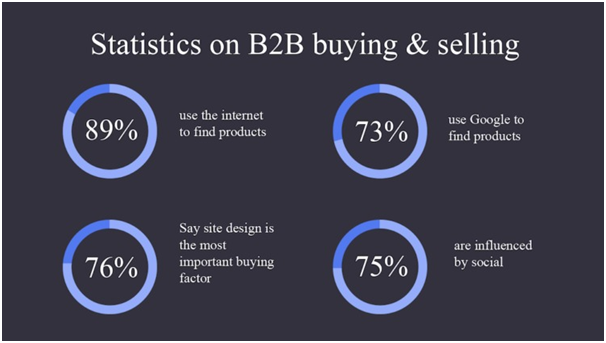
Your site design can deliver better conversions because, according to BigCommerce, it’s the critical factor influencing the buying decisions of 76% of B2B buyers.
Remove any unnecessary design elements that could be distracting your visitors. Do you really need to highlight your company events on your homepage? Or what about that low-quality image that takes over the entire screen?
Simplify Your Forms
In this same way, you should also review your signup forms and sign-in pages to see what you can remove or improve. Perhaps you don’t really need to ask for their company address unless you’re delivering a physical product. Or you could start by giving them a one-click sign-in option where they sign in using their social media accounts.
For instance, Venture Harbour made three simple tweaks to their homepage design. They simplified the hero section of the page by replacing the CTAs and buttons with a simple message to relay their key selling point. They improved their forms by switching to intuitive multi-step forms to capture customer information without losing their interest:
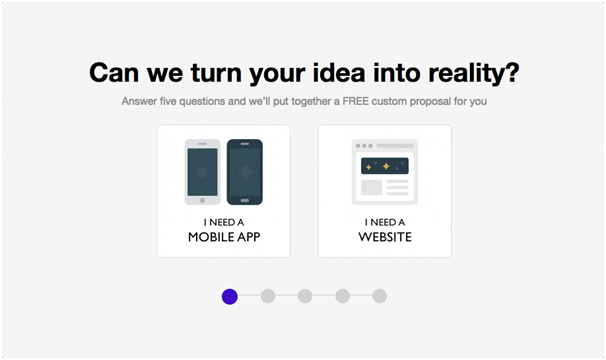
And, instead of selling their services through their hero section, Venture Harbour also opted to showcase compelling copy to highlight how they have helped other businesses. Instead of making baseless claims, they showed proof of the results they can deliver. Together, these three tweaks increased their conversion rate by 500%.
2. Promote Your Content More Strategically
Some B2B companies go all out when promoting their content. They share it everywhere and send notifications about every new piece of content to every subscriber.
While this blast of content may seem like a good idea if you want people to consume your content, it may not necessarily boost conversions. It could even end up annoying people if it isn’t relevant to them.
I recommend taking a more strategic approach to distributing your content. This is very easy to overlook when you’re focused on other aspects of your B2B content marketing strategy, but it can help you plan how to promote your content to specific leads and customers depending on which segment they belong to.
This means you will be showing them more relevant content that is also more likely to guide them through the sales funnel. You could promote your beginner’s guides and 101s to new leads, for example. Or you could send case studies and testimonials to leads that are further down the funnel.
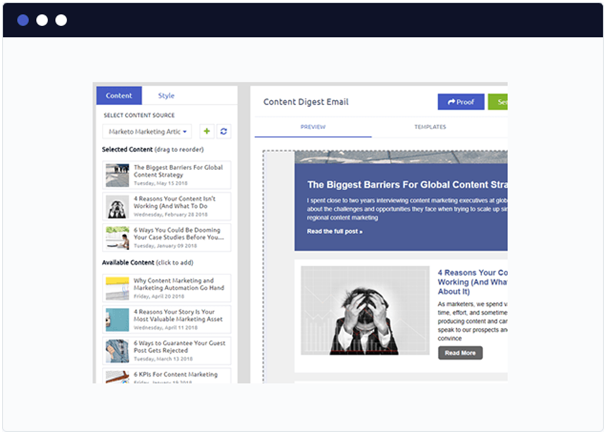
You can start out simple with curated newsletters customized for different segments. Sort your recipients into different segments based on where they are in the funnel and perhaps other factors like department, job role, etc.. Then you can curate some of your best content that will be suitable for each segment rather than hitting everyone with every piece of content.
You can use platforms like FeedOtter to simplify this process. It lets you add content from different sources and easily re-organize them with a drag-and-drop feature. You can even add a personalized greeting and intro to these newsletters for an even bigger impact. Check it out:
Use Retargeting to Promote Content
I’d also recommend using Facebook Pixels to retarget people who have shown interest in your business before and have a strong chance of converting at some point.
Retarget them with ads promoting content relevant to what they have viewed before. For instance, you could pay to promote an ebook on email marketing. But you would only target people who have read your blog posts on similar topics or viewed your product feature page on email marketing.
There’s plenty of proof this works, including this case study from Facebook Business. Hawke Media executed a strategic content promotion plan, using long-form content to raise awareness in the first stage. They then created ads to target a Custom Audience and Lookalike Audiences according to their email and client list, CRM leads, and traffic. Finally, they used their engagement data to retarget the most relevant audiences with more tailored ads:

As a result of this comprehensive content promotion strategy, the agency saw a five times increase in blog readership within a year. They also had a 4X return on ad spend, while reducing their cost per lead by 78%.
3. Combine PPC and SEO
This is where a lot of businesses—especially emerging ones—struggle. PPC and SEO each have their unique benefits and drawbacks, so it’s difficult to choose which one to focus on. Which will be more effective to optimize B2B conversion rates?
SEO helps you bring in more organic traffic and delivers long-term results at minimal cost, theoretically. But, at the same time, its impact is slow. You could spend months and hundreds of dollars on content production before you start seeing any results.
PPC, on the other hand, brings in immediate results as it enables precise targeting. But since you get charged for every click, these campaigns tend to be more expensive, even if they do improve conversions.
PPC campaigns may seem like the logical option for conversion optimization. But from how I see it, this isn’t an “either/or” situation.
You don’t have to choose between SEO and PPC. Use them together to deliver better results and improve B2B conversion rates. I suggest using your SEO keyword data to optimize the performance of your PPC campaigns, and vice versa.
Use SEO with your PPC…
Are there any long-tail keywords that have been converting visitors organically? If they’re driving organic conversions, clearly it means they are helping you attract a relevant and interested audience. Giving them a little leverage with PPC campaigns could drive even more conversions.
You can even take this up a notch. There may be some keywords for which you’re ranking organically even when you haven’t made any effort to target them. This means that the keywords are clearly working for you since they are delivering results even without effort.
You can use tools like Pro Rank Tracker to discover keywords for which you’re already ranking organically but are unaware of. You just need to enter your URL in the search bar, and it will give you a complete report of all of the keywords for which your website is ranking. This will include a section of keywords for which you are ranking but aren’t currently tracking. Here’s an example of what this looks like:

…and PPC with your SEO
Similarly, you should monitor the high-performing keywords in your PPC campaigns. This will help you identify the search terms that people typically use when they click on your ads and understand user intent in the process. So put together these top-converting keywords and use them to optimize your organic content.
You can take your approach even further by using PPC to target organic keywords that get a lot of searches but are too competitive to rank for organically. With highly competitive keywords, it will take you months and a lot of effort to organically rank for them on the first page of Google SERPs. So boost your efforts by targeting these keywords in your PPC campaigns, which will get you quick and effective results.
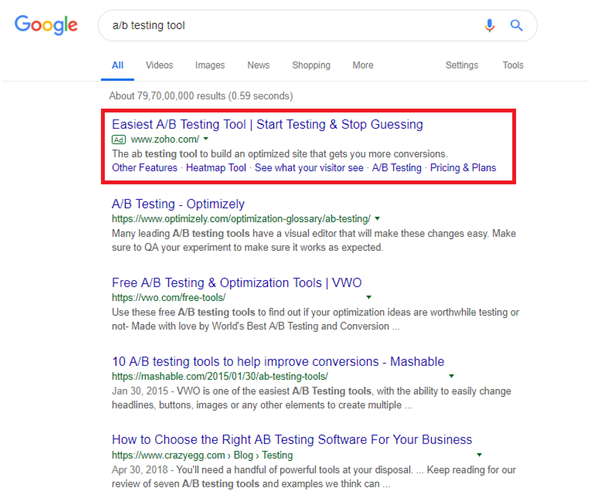
For instance, Zoho isn’t ranking yet on the first page of Google results for the keyword “A/B testing tool” since it’s quite generic and likely to be very competitive. But if you look at the screenshot below, Zoho does shows at the top of the page because they’re targeting the keyword with a PPC campaign. Zoho has paid to surpass the organic results for their top competition such as Optimizely and VWO:
How Do You Improve Your B2B Conversion Rates?
These are some of the best B2B conversion optimization practices that you might be overlooking, especially if you’re just starting out.
But if you haven’t overlooked these suggestions, my final piece of advice is that you should keep looking for new opportunities to optimize your approach for better B2B conversion rates. It’s an ongoing process that you revisit more than once, and chances are there are any other improvements you could be making.
Got any questions (or doubts) about these practices? Let me know in the comments below.

Original Source: 3 B2B Conversion Optimization Practices You’ve (Probably) Overlooked
Tuesday, April 9, 2019
9 Higher Education Email Marketing Strategies for Better Student Enrollment
Social media, instant messaging, chatbots, and programmatic advertising have changed the digital marketing landscape. A generation of consumers has grown up with mobile devices in their pockets, changing the way they interact online.
Generation Z, students born between 2005 and 2015, rarely sit in front of a desktop for extended research sessions when they’re seeking information about products and services. They search from different devices across multiple platforms throughout the day to learn, to compare, to ask questions and to buy.
In this environment, email seems old fashioned, an outdated marketing method, yet email marketing spending in the U.S. is expected to reach a high of $350 million in 2019.
There is a reason for this.
Although email is the oldest form of digital marketing, it remains a vital component of a marketing strategy.
Carefully crafted messages sent to the right consumer at the right time can further marketing goals better than targeted paid advertisements. Emails have a more personal appeal than broadcasted social media content and banner ads, and email is read in a less distracting environment than other media messages.
Blasting the same email message to every address in your database is a waste of resources, and will annoy many recipients. But, targeted emails, as part of a multi-faceted recruitment campaign, will bring results.
Follow these strategies to fine-tune your email marketing to build your institution’s brand and increase enrollment numbers.
1. Segment your email list
Your database of email addresses comes from a wide range of potential students, their parents, high school guidance counselors and others that have responded, at some point, to an outreach campaign.
You may have collected some addresses through a landing page offering financial aid information, or a user may have entered an email address to download a PDF outlining your engineering programs.
While you may begin with little data on the people at the other end of an email address, you’ll collect data about who they are and what they need as they respond, or don’t respond, to your email messages.
Segmenting your list based on the data points you collect makes it possible to target prospects with marketing messages they’ll find most useful. This, in turn, will increase click-through rates and conversions.
For example, you may choose to segment your master list into demographics such as age, financial situation, and geographical location. Further segmenting by demonstrated interests, such as field of study or specific campus social activities, will ensure you’re sending the right message to the right person.
2. Align messages with the buyer’s journey
Prospective students travel a path from initial curiosity about college study to filling out admission paperwork.
Create a map of this path and create content to meet your prospects’ needs at each point along the way.
The data you gather as you interact with prospects, through email CTAs, social media, and by tracking their activity on your website, will inform you of where they are on the buyer’s journey.
Then, you can send content tagged to meet that specific point.
A student in the awareness stage of a journey may not be ready for an invitation to meet with an admissions advisor, while general information about degree programs and student life would be welcome.
3. Use intriguing, but honest, subject lines
The email subject line prompts the recipient to either open or delete a message.
For a positive response, keep the subject short and to the point.
Use action verbs in the subject such as “Explore our new science programs.” Spark curiosity, for example, “What students are saying about the new media center at XYZ University.”
Consumers have become cynical about advertising, so avoid hyperbole and language that sounds like a sales pitch.
Be sure your email content delivers what the subject line promised. Few recipients will tolerate misleading subject lines, and your next message may be marked as spam.
4. Tell a story for emotional appeal
It’s the science behind “show, don’t tell.”
The human brain is wired to respond to narrative. A story reaches people on an emotional level. Stories are memorable; they leave an impression. Craft your email messages with this in mind.
Sales pitches and trite claims – “Make friendships that last a lifetime” – are quickly passed over as a recipient scans an email text.
Prospective students will engage with detail-rich stories that help them make a connection between their self-concept and your institution.
For example, a campaign to introduce campus life should include concrete examples of co-curricular activities, the local social scene, and cultural offerings.
Review the analytics for your website and social media platforms. What are your most popular pages and posts? These will be good email topics as well.
5. Be authentic, be human
Reinforce your message, and build your institution’s image, with testimonials and case studies that profile current students and alumni.
Speak in a voice that will resonate best with your target market (professional advice is influential in some cultures; others will respond better to recommendations from peers) and keep a consistent voice throughout all campaigns.
Prospective students want to feel they are interacting with humans, not a marketing campaign.
6. Include rich images and video
Email does not have to be solid text.
Gen Z has been raised in a culture of multi-media learning and responds to powerful visual cues.
Thought-provoking images and entertaining videos are effective ways to promote programs, introduce members of the school community and demonstrate that your institution engages in the newest technologies.
Consider the impact that a virtual reality tour of dorm rooms will have in an email outlining housing options or a 360-degree photo of a state-of-the-art science lab for prospects contemplating study in the sciences.

Loughborough University 360 lab tour
7. Optimize for mobile
Many in your target demographic began using smartphones and connected tablets as elementary school students. Mobile devices are their first choice when it comes to interacting with the digital world, and they will check their email throughout the day from a cell phone.
It’s critical that your email messages display correctly if you expect recipients to read them.
Identify which devices are popular with your target market and select responsive email templates that will provide the best possible user experience.
You’re only a tap away from communicating with potential enrollees; don’t frustrate them with a poorly designed template.
8. Automate
From the initial “thank you for subscribing” message to well-timed offers, event announcements, and informational content, engage prospective enrollees using marketing automation software.
Identify points along a student’s decision-making process to target and create email messages that answer questions, address pain points, arouse curiosity and encourage further engagement.
Recipient actions, such as following an embedded link or viewing a video, will trigger the next logical step on their path of inquiry.
Data collected as people engage with, or disregard, your communications, can be used to further segment your database, increasing click-through rates and moving a prospect closer to enrollment.
9. Reengage and disengage
An email list, to be cost-efficient, requires maintenance. Bad addresses, unsubscribers and inactive recipients are a drain on resources and put your email messages in danger of being labeled as spam by ISPs.
A bounced email means the address is invalid, and it should be removed from your database. Either the subscriber entered the address incorrectly or the account was closed.
Monitor unsubscribers as they provide useful data on the effectiveness of your targeting. Which emails are prompting subscribers to leave? Are you sending too often? Does your frequency need adjusting?
Recipients that don’t open your emails, or open them but don’t take the desired action, may need a reengagement email. A simple “update your contact information” request may be enough.
Other ways to reengage subscribers is to send surveys or offer premium content such as an eBook outlining financial aid opportunities.
If a subscriber fails to reengage after one or two reengagement efforts, it may be time to remove the address from your database.
An integrated online marketing platform can simplify these strategies, streamline your email marketing, and accelerate your recruitment campaigns. Contact our GetResponse representatives to learn more about tools for creating engaging email messages, managing email lists and automating email delivery.


The post 9 Higher Education Email Marketing Strategies for Better Student Enrollment appeared first on GetResponse Blog - Online Marketing Tips.