Wednesday, January 31, 2018

NEW: Inbound Sales Certification Program
Have you taken any of our online courses in the GetResponse Digital Marketing Certification program? If you have, then your LinkedIn profile is probably boasting a brand new certificate, and headhunters keep sending you irresistible job offers. At least we hope so!
Today, we’re announcing the latest addition to the program: the new Inbound Sales certification course.
Here’s why you should be the first to take it!
Inbound sales, the ultimate lead generation machine
Inbound sales is all about creating a complete buyer journey experience. From email marketing and marketing automation, to webinars, SEO, and PPC, to social media, our experts will teach you how to build that one effective customer lifecycle strategy. So if you look for new ways to generate leads and convert them into loyal customers, look no further.
In this course, you’ll learn how to:
- Define your ideal buyer profile.
- Generate leads with multi-channel marketing.
- Move qualified leads through the sales funnel.
- Use CRM and emails to close sales.
- Build retention programs to get more conversions.

But that’s not all! To build this innovative program, we asked our best experts for help, including the GetResponse Head of SEO, Email Marketing and Content Marketing Managers, and an internationally recognized speaker, Jamie Turner.
Wait, Jamie Turner contributed to the program?
Yes! Jamie spent the past several decades showing clients such as AT&T, CNN, Coca-Cola and Holiday Inn how to get more “R” from their marketing ROI. He now works with small and medium businesses to improve the results of their campaigns. Plus, he helped us build the Inbound Sales program that’s tailored to their needs.
Here’s what you’ll find inside this course:
- 10 teachers
- 19 lessons
- 146 minutes of training
- 1 industry-recognized certificate
Why get certified?
A certificate proving you know how to plan, launch, and track highly-targeted lead generation campaigns is a valuable career asset that’s worth showing off. But you get more than that!
Once certified, you can showcase your services on the GetResponse Marketplace, entirely free. We’ll also invite you to our top secret community for certified experts who want to stay in touch.

So, ready to dive in?
Take the course and become a certified inbound sales expert today!


The post NEW: Inbound Sales Certification Program appeared first on GetResponse Blog - Online Marketing Tips.
Tuesday, January 30, 2018
Want More Webinar Signups? Try our New Landing Pages Feature!
At GetResponse, we’re always busy tweaking the tools you need to build, grow, and scale your business. And we know you’re focused on getting more leads. After all, last year around 85,000 new contacts signed up to our customers’ lists every day.
Webinars played a big part in that growth, proving to be a powerful lead generation tool. But we know preparing for webinars isn’t always easy. That’s why it’s a good idea to build a landing page to promote your webinar, and outline the topic, speaker, and key takeaways.
To make this even easier – and help you get more webinar attendees – we’ve added a brand new feature to our landing pages.
Visitors to your landing page can now sign up directly to your webinar, without any extra steps.
How to use webinars with landing pages
Step 1. It’s super simple. Start by setting up a webinar inside your GetResponse account.

Step 2. Then go to the Landing Pages creator, and choose your favorite webinar template.
[You can also choose any other template or even create one from scratch. In such case, you’ll just have to drag and drop the camera icon onto the page to add the signup form.]

All our templates have been revamped to make it even easier to get started.
Step 3. Next, you’ll need to choose a webinar to link the landing page to.

You can use this feature if you have webinars enabled in your GetResponse account.
Step 4. Your webinar signup form will now appear on the landing page.

And of course, you can place it anywhere on the page.
Your turn
Stay tuned – we have another exciting landing page feature on the way!
Until then, you can join the conversation in our Landing Page Experts Facebook group and share your experience with our growing community.


The post Want More Webinar Signups? Try our New Landing Pages Feature! appeared first on GetResponse Blog - Online Marketing Tips.
No-Touch CRO: 11 Ways to Optimize Your Website without Touching Your Website
Wait a minute, no-touch website optimization? How on earth can you optimize your website without touching it? That’s absurd. Insane even. Have you gone stark raving mad, Oli?
Who me? Never! Or at least, not all the way crazy. I’m talking about ways that you can experiment, learn, and change behavior simply by using page and UI elements like Popups and Sticky Bars. An approach I call no-touch CRO (conversion optimization).
What is No-Touch CRO?
Kinda like the title suggests, no-touch CRO is about uncovering, exploiting, and maximizing the conversion opportunities that exist on your website. It’s all about velocity, getting results, and learning quickly and easily so you can make informed updates and optimizations to your website backed by data.
Here’s how it works in a nutshell. You install the Unbounce script on your site once, and then you have access to creating experiences on every page, without touching any code or design on the site.
Think of it as a layer of abstraction that exists above your site. Like literally.
“Are you doing that product awareness thing again, Oli?” Yup. I most definitely am. But only because I think the 11 ideas below are badass, and it’s how I like to work.
(Skip to the 11 website optimization ideas).
Navigating the Politics of Website Optimization
The reason I like this approach is because the politics of website development, design, and optimization are a complicated and slow-moving pain in everyone’s ass. The number of stakeholders, sign-offs, reviews, and revisions that are necessary to get a change implemented are always underestimated. Not to mention budgets, different departmental priorities and needs, and of course time. It’s basically a giant cluster that needs to be navigated proactively.
Which is why, if you can come to the table with some evidence that your ideas can affect positive change, those same naysaying stakeholders will become advocates for your work.
Now, I’m not suggesting the first thing you do is to start hammering your pricing page visitors with popups. You have to be smarter than that. Starting small, on low-traffic pages, and using techniques that are legitimately useful for your visitors, and provide as much evidence and learning as possible. The more successes you can show, the greater the bounds of your website optimization freedom will be in the future.
I’m going to share 11 ideas for you to get started with no-touch website optimization using popups and sticky bars, but first, you need to get your web developer to install the script on the website.
Your developer may have some questions such as: How big is the script? Which pages does it need to be added to? We interviewed two of our web developers at Unbounce to understand these concerns, and it was enlightening to hear about their process, and what they check when considering adding another script to the site.
We found that it’s typically a 1-2 day turnaround to get a new script installed, based on the research they need to do regarding page speed and bug testing etc. But one of the most interesting parts to me was simply the desire for the web developer to be included in the process. They didn’t want marketers installing it on the site themselves because it’s a serious concern that needs to be handled properly.
A big positive insight was that the amount of features available in the Unbounce platform (for triggers, targeting, and timing) allows significantly more functionality, interaction, and marketing campaign content without any requests of the developer’s time – making it a big win-win overall.
Just make sure you involve your developers.
If you have Google Tag Manager set up on your site, it’s even easier to get the Unbounce script added. Send this post about adding the Unbounce script using GTM to your web developer now.
11 No-Touch Conversion Optimization Opportunities You Can Take Advantage of on Your Website
Alright! Time to start optimizing your website without touching your website. Here are eleven creative ways to increase the number of conversions, and insights you get from your website.
#1: What on earth are you clicking on?
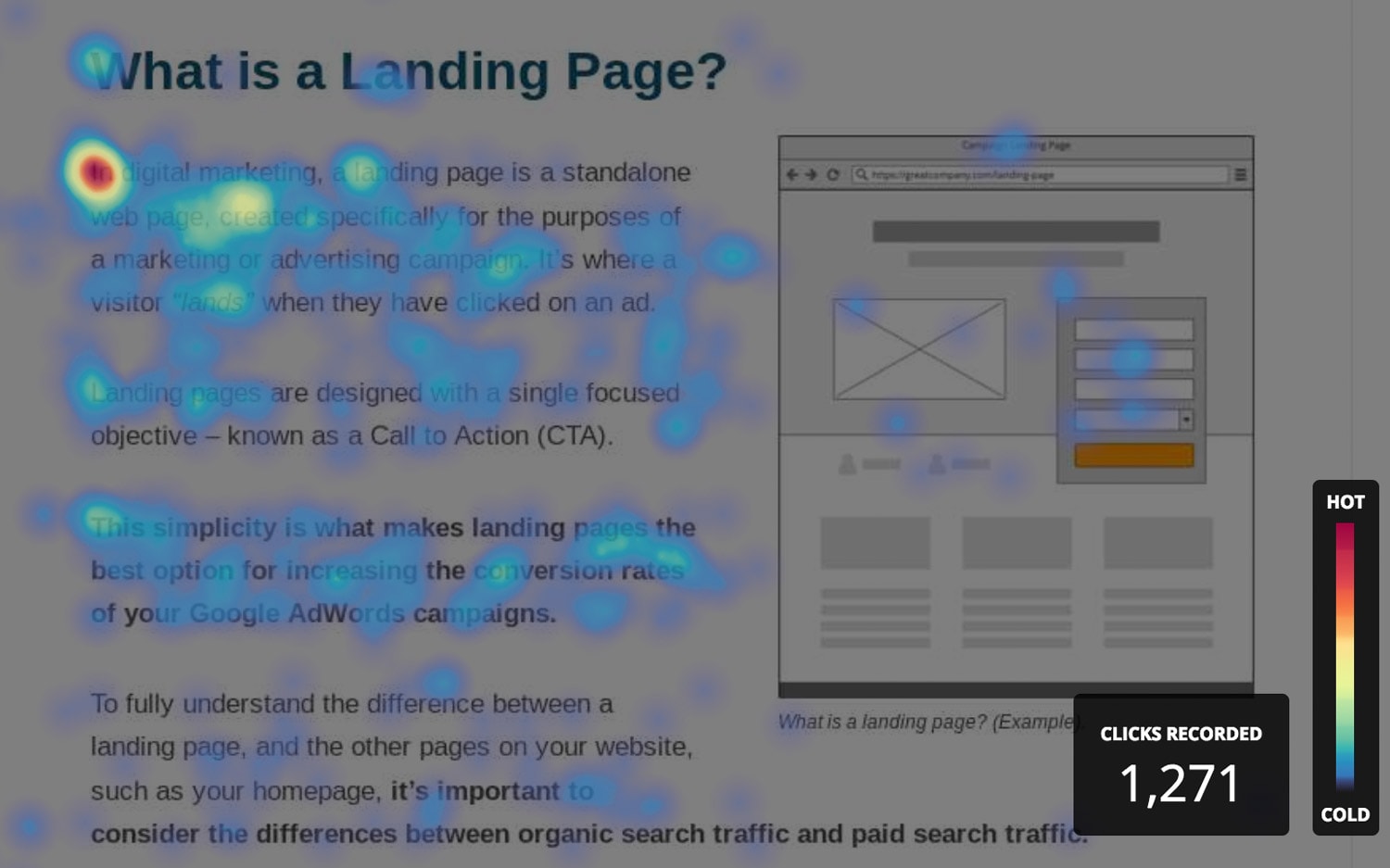
If you are a frequent observer of heat maps you’ll have no doubt seen big splotches where many people are clicking a page element (word, image etc.) when the element isn’t even clickable.
There can be several reasons for this:
- It’s just what people do when they read
- They are expecting something to happen
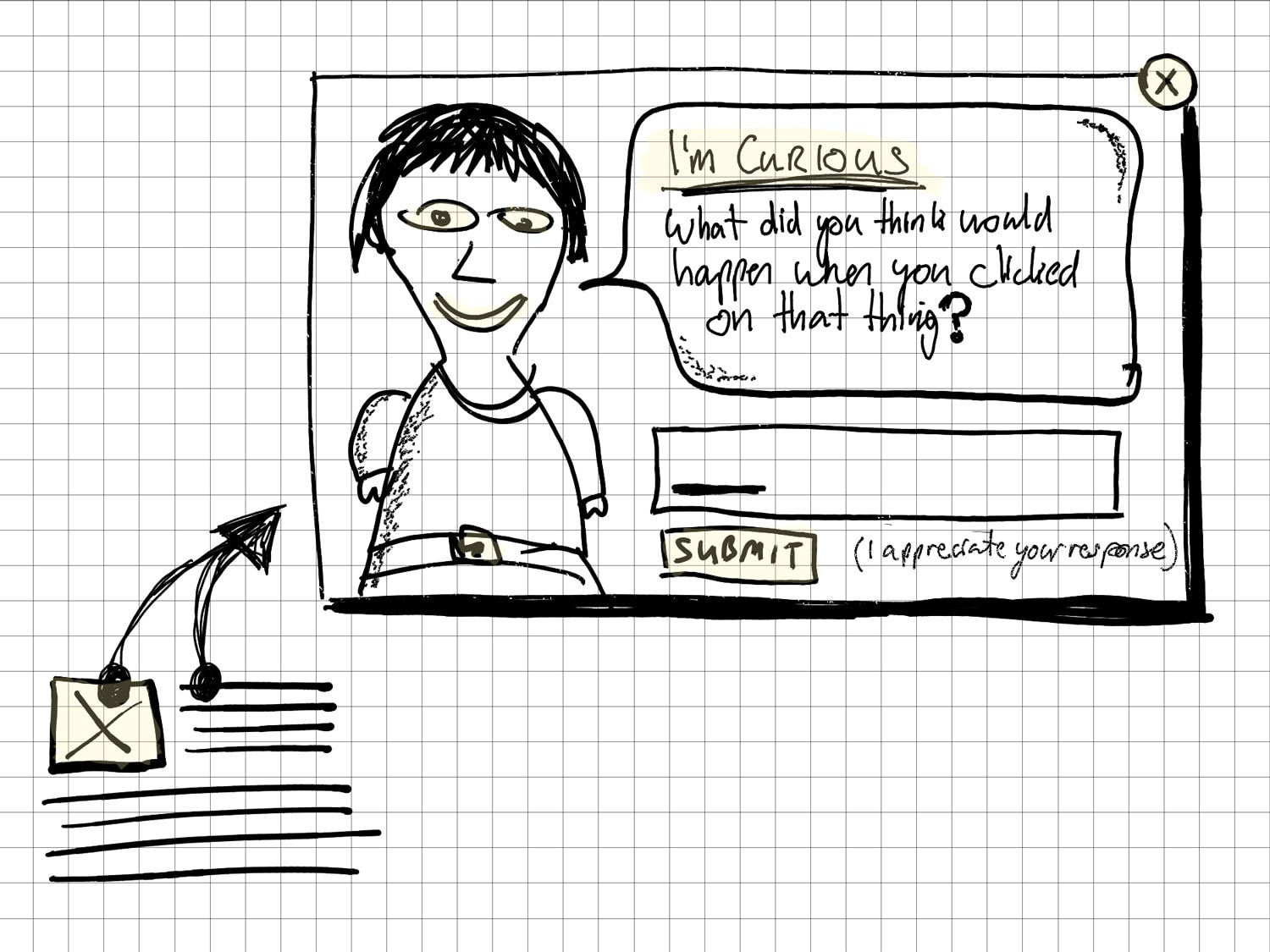
In the case of option B, there’s an opportunity to learn why they are exhibiting this behavior and ask them what they expected to happen.
You can do this by using the click trigger to launch a popup with a simple open-ended question such as “What did you expect to happen when you clicked that?” or “What are you looking for?”.
Conversion Implications
The responses from these research questions could inform you as to a missing part of the experience which you can then consider adding to the website, either directly, or after an A/B test of some kind.
An Unbounce Example
When I was researching behavior on our “What is a Landing Page?” page, I noticed interesting behavior on the first paragraph, where the first word was really strongly highlighted. I had two theories about this:
- It’s just a thing people do when they start reading.
- People were clicking on the first word and then dragging their mouse to the end of the first or second paragraph to copy the text. Because the page is a very well written and simple definition of what a landing page is, I hypothesized that people doing research who needed a definition to include in their content were copying the definition.
To confirm this I watched some session recordings and observed someone doing this. I also searched Google for my newly written definition and found over twenty sites had done exactly that. Inbound links FTW.
#2: Create a Custom 404
Wouldn’t you like to know what people are thinking when they’re on your 404 page? If you dig into your analytics you’ll be able to figure out where they came from, but where should they go next?
By using a popup on your 404, you can take advantage of several conversion opportunities:
Option A: Research & Redirect
If you can establish where people are coming from (in order words, where the broken link is), you can use the referrer URL targeting in Unbounce to create a custom experience for them.
If the broken link is on your own site, you can get that fixed, or a 301 redirect put in place to a relevant page and if the broken link is on someone else’s site you can reach out to them for an update.
However, both of those options take time and resources to accomplish. You should put them in motion regardless, but in the meantime, there’s plenty you can do to learn and optimize.
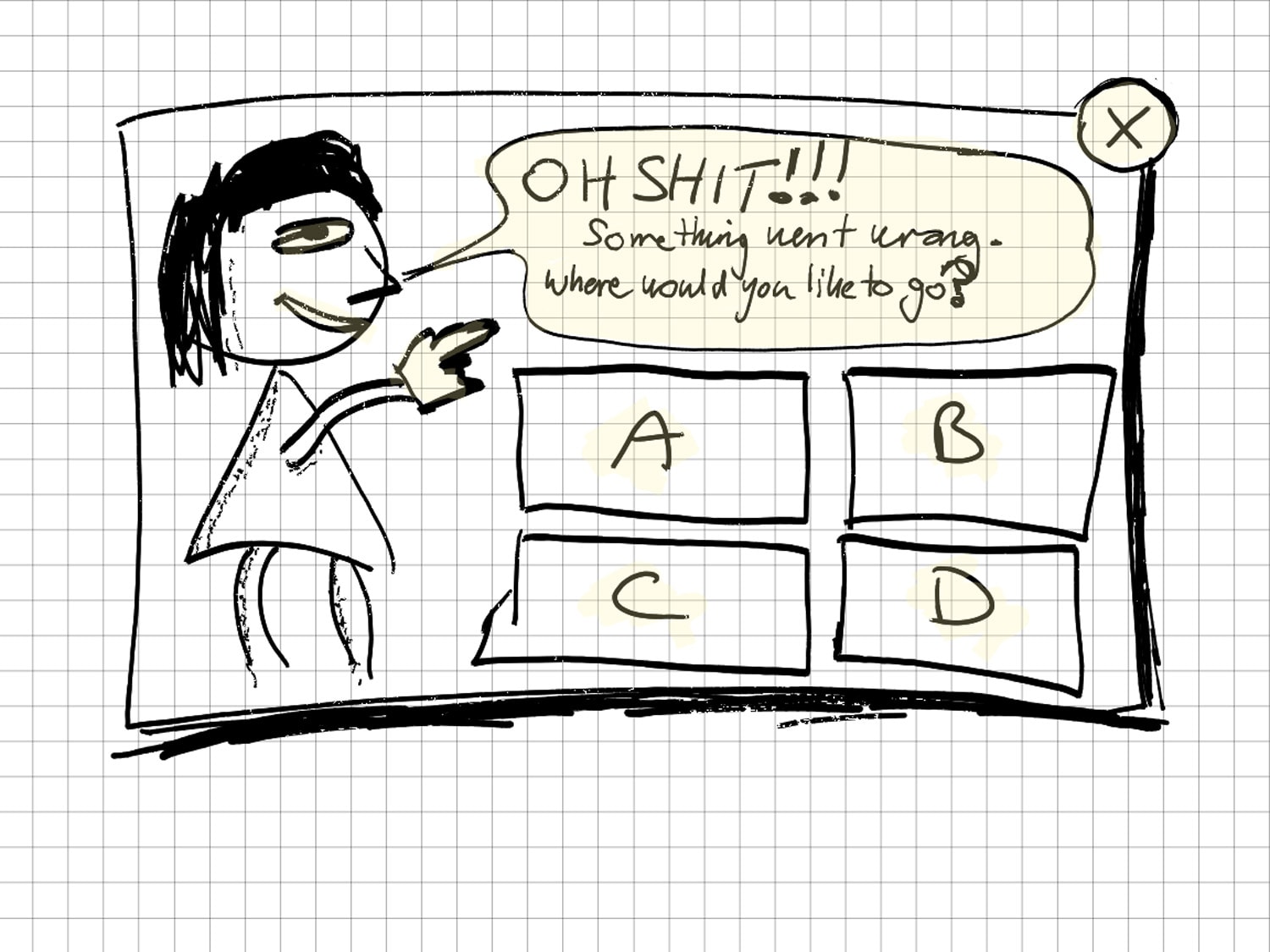
This is a great place to experiment with a Choose Your Own Adventure (CYOA) experience to see what the preferred next step is. If you can show a pattern of next step desire here you’re ready to make a more permanent 301 redirect to the popular choice.
An open-ended question like “What were you looking for?” coupled with a few large buttons that redirect people to some of your critical path conversion pages.
Option B: Replace
Something you might not know is that if you use the Unbounce WordPress plugin for your landing pages, there’s a way to replace a broken link with a landing page.
When using the WordPress plugin, any URL you set up on your domain in Unbounce will assume dominance over an existing page. Now you most likely don’t want to do this with a legit page that’s working. But for a broken link you could publish a landing page using the very same URL to present an experience that you are in full control of – no developers required.
Warning! Don’t simply go overriding pages all over your website (unless you own it fully). Let your web and marketing coworkers know what you’re doing.
#3: The Login Hijack
I introduced The Login Hijack in my 5 Legitimately Cool Use Cases for Website Popups You’ve Never Considered post. The concept is to create an experience based on the information that you (probably) have a large % of visitors (customers in this case) only showing up to click the login link.
Note: You need to drop a cookie on your login page to identify customers, then you can use the cookie targeting in Unbounce to show the popup when they return next time.
This is a perfect place to insert some product marketing content. Here are two ideas:
Idea #1
Run a “did you know?” survey to measure new feature awareness. This could take the form of a series of large buttons with product or feature names on them, and a request to “Click all of the features you were not aware of.” The heatmap on this could be fascinating. Don’t forget to also include a login link so customers don’t have to click to close the popup before proceeding.
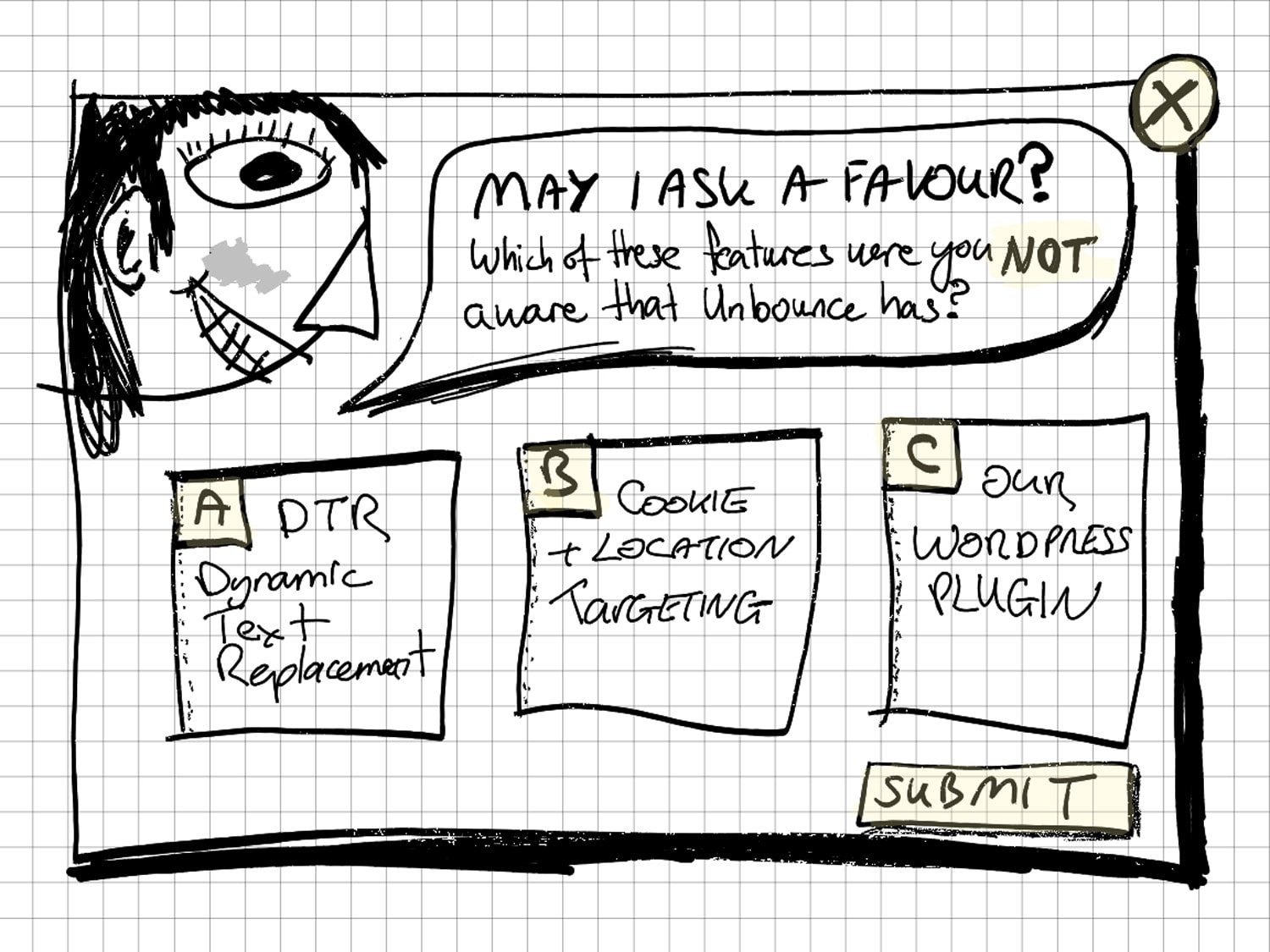
You could also include a login redirect after the question is answered to prevent the need for an extra click.
Idea #2
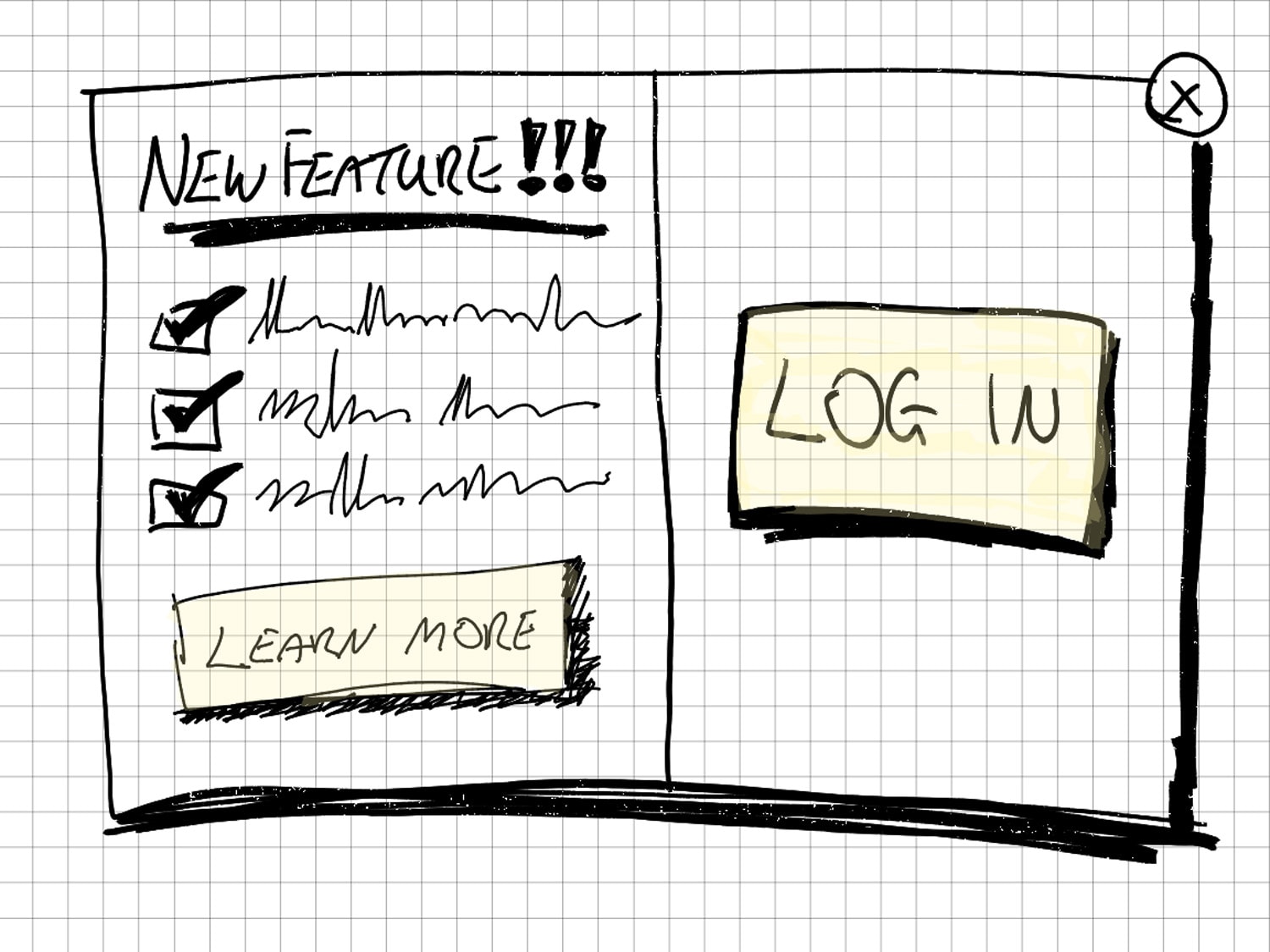
Present a popup with a 50-50 vertical split. The left side can present information about a new product or feature with a “Learn More” button, and the right half can provide a large login button. Not only does this allow you to get product messaging in front of your customers, it also makes the login link/button bigger that it would have been.
#4: Advanced Video Interactions
If you have any videos on your website you probably have a call to action at the end. This is great. Until you look at the engagement data and realize that 50% of people never get to the end.
You can get around this problem with a very cool interaction model that Unbounce Noah Matsell built.
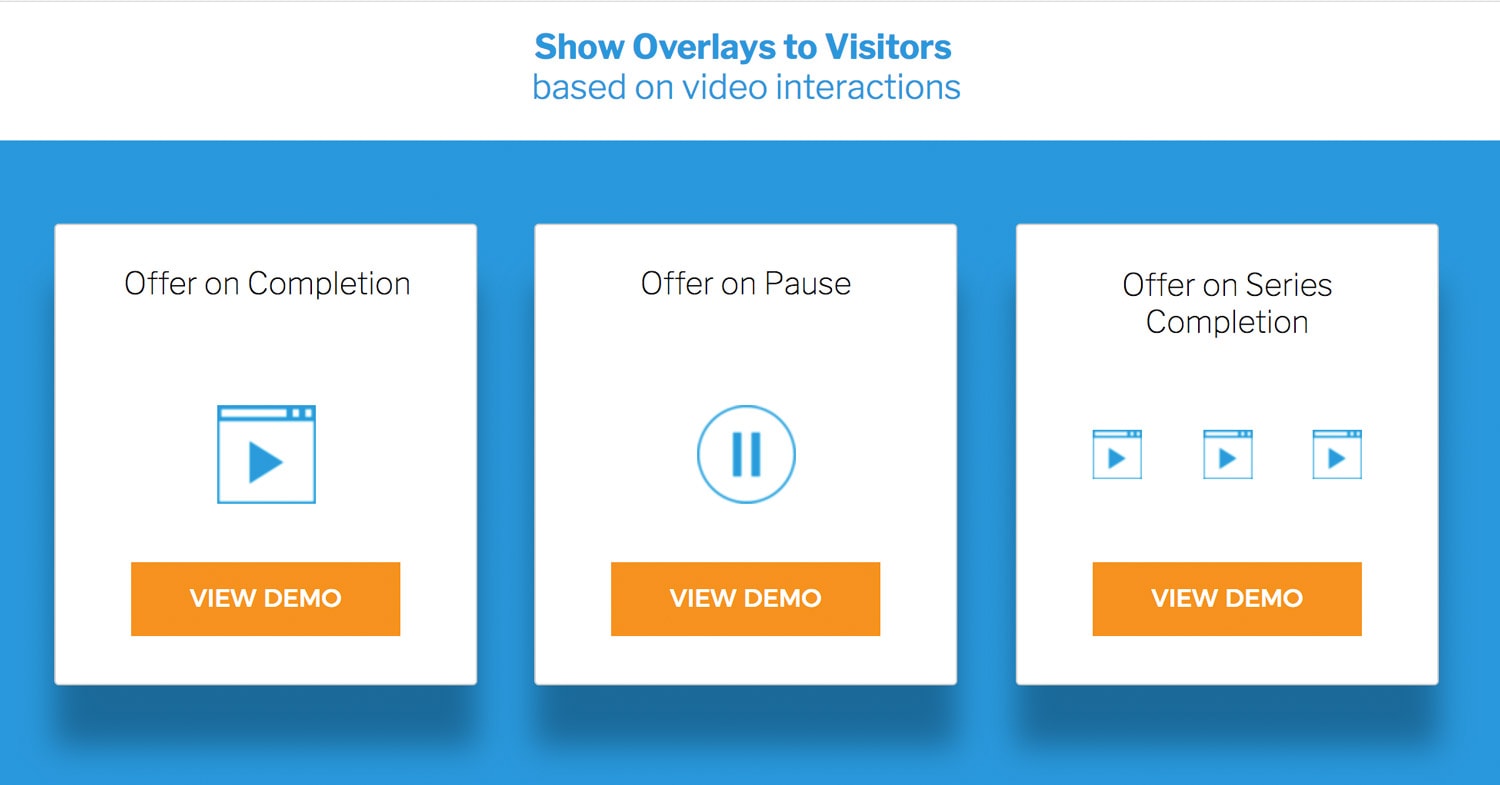
Using this method (requires a little Javascript – ping me at oli@unbounce.com if you’d like it), you can present your visitors/customers with a popup based on 3 different levels of interaction.
On completion
When the video has been watched to the end. Note that a popup presents a significantly large area to present an offer than the typical text/button CTA that appears in the middle of the video window. You can even instruct people to watch the whole video to get a special offer.
On pause
This idea ups the cool factor for me. You can present an offer if someone pauses the video. A great place to ask a question (“Why did you stop watching”), or to present your offer right away.
On series completion
Saving the best for last, this implementation allows you to monitor the viewing of several videos, show a live progress bar, and then present a reward/prize/offer when all of the videos have been watched.
This is great if you have a series of videos that you want to encourage people to binge watch Netflix-style, like The Landing Page Sessions, or a set of instructional videos that guide a new customer through a training or onboarding sequence.
#5: Choose Your Own Adventure (CYOA) entrance experience
Do you have different target customer segment? At Unbounce we consider agencies and in-house marketing teams to be our ideal target customer archetype.
Given that you most likely have multiple ideal customer types, should they all be getting the same experience? No, of course they shouldn’t. But designing multiple experiences can be difficult. Which is why some experimental experiences can be incredibly eye-opening.
I’m a big fan of the Choose Your Own Adventure (CYOA) approach, and it’s not hard to create a few custom flows for your visitors.
By using an entrance popup with a simple self-identification question, you can drop cookies that help you create more customized experiences in other areas of your website.
I’d start with an “I’m an Agency or Marketing Team” type question.
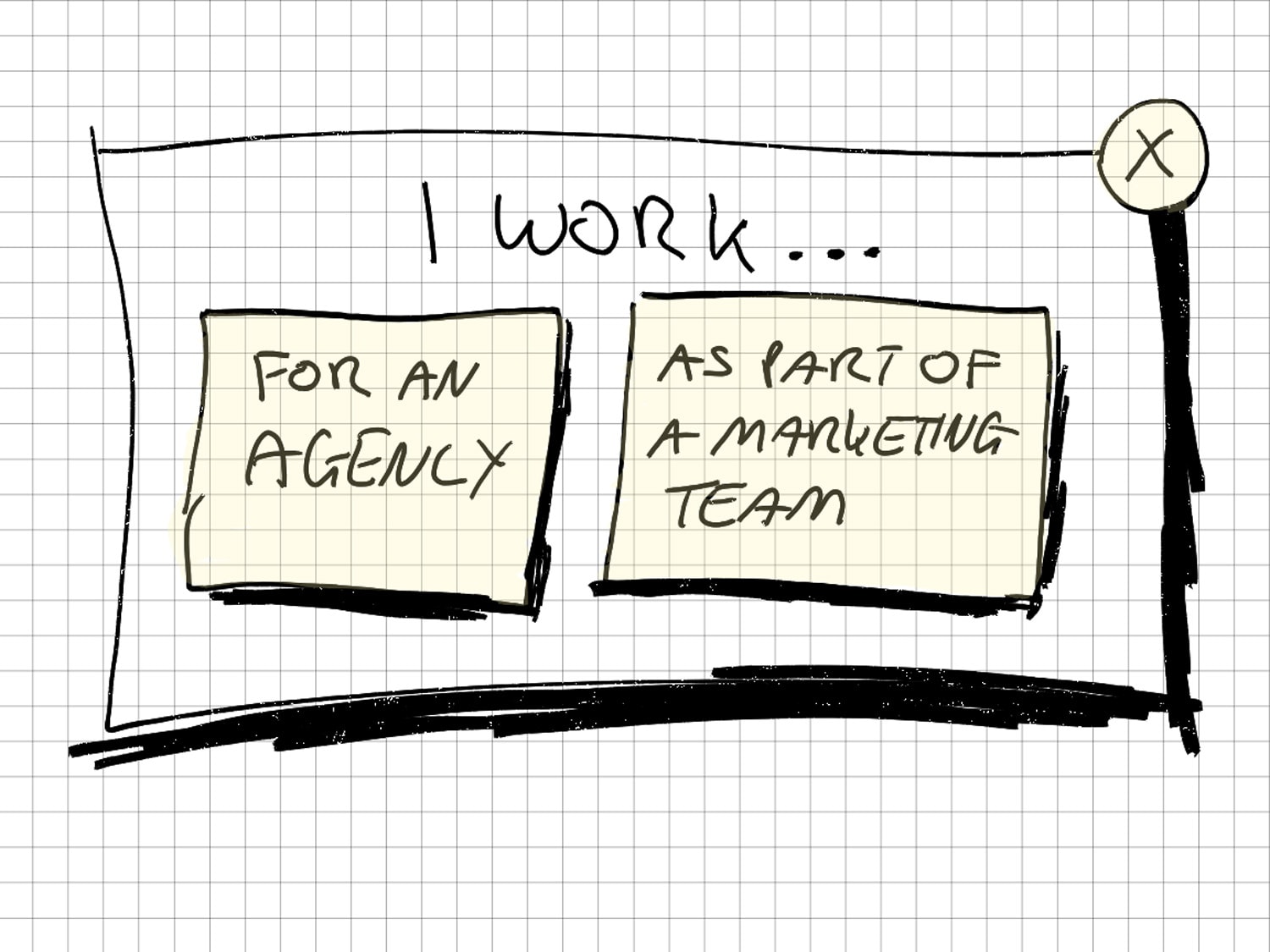
Once you’ve dropped the cookie(s), you can take that knowledge and create experiences elsewhere on your site (or other web properties), and you can redirect the visitor to the best experience you have on your site for that persona.
For example, if someone self-identifies as working at an agency, you could provide an agency-specific resource or offer if they try to exit your site on the pricing page. For example, “Did you know we offer an agency program that includes a, b, c ?” or “Would you like a demo of Unbounce with one of our agency specialists?
There are almost infinite ways you can leverage this approach just by asking once for people to identify themselves.
And once again, you didn’t have to change anything on your website.
#6: G2 Crowd awareness
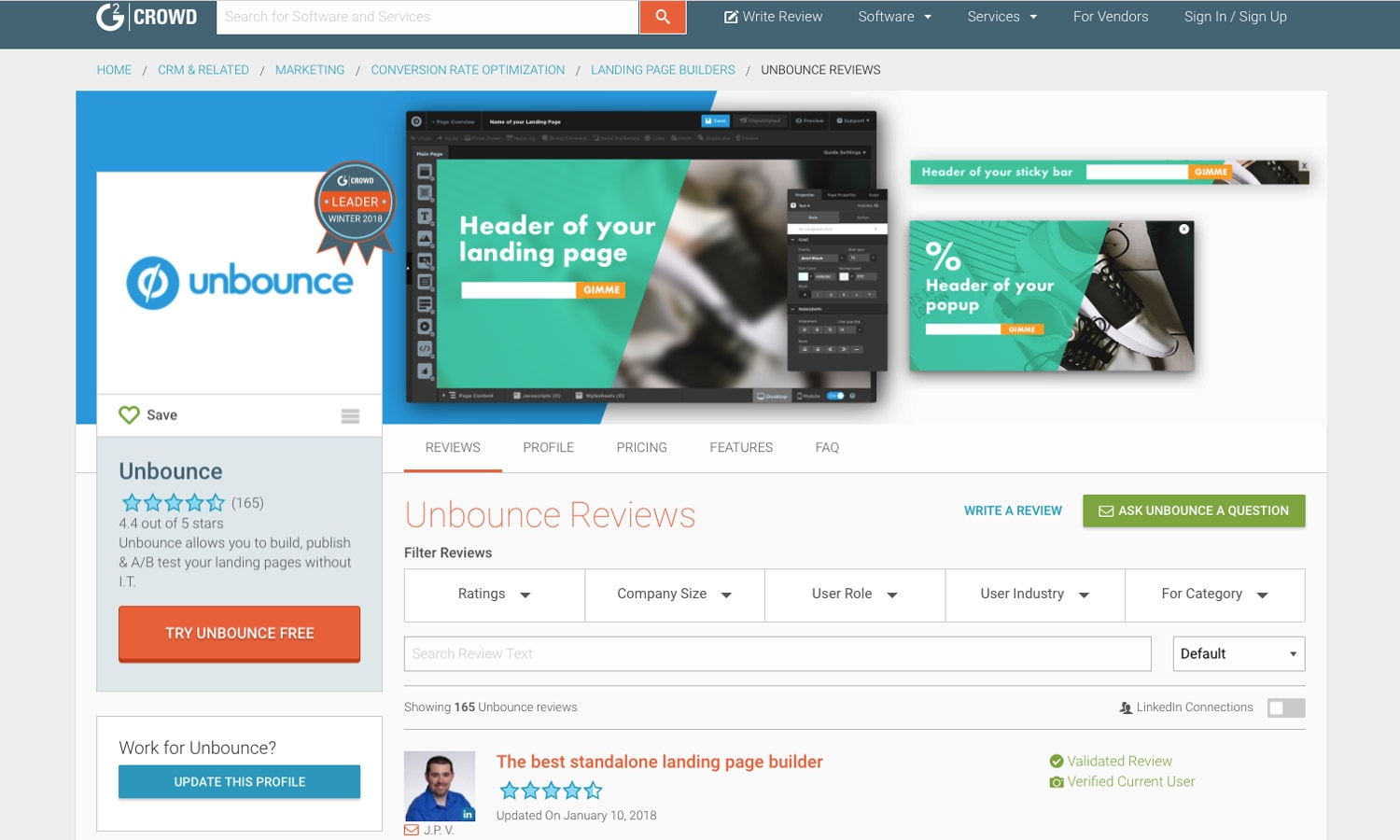
Got good reviews on G2 Crowd or Glassdoor? Embed some of the details on an entrance sticky bar for visitors to your “About Us”, “Team”, and “Careers” pages as social proof.
You could take your rating, a badge, or a review to use as social proof.
#7: G2 Crowd reviews
Ask customers (use the cookie you dropped on the login page for the login hijack example) to rate you on G2 Crowd. As you’re dealing with customers and they already do a lot for you, I’d suggest making this a subtle sticky bar and not an in-your-face experience.
#8: Welcome back MVP
If you know what your most important pages are you can use cookies and cookie targeting to drive people to them.
In my Advanced Triggers and Targeting post, I presented the “You Didn’t See My Most Valuable Page (MVP)” concept, where you set a cookie when visitors see your most valuable page(s). That way you can check for the existence of the cookie whenever someone leaves your site, and show them a popup directing them to the important content.
Using a similar approach, you can provide an entrance experience that welcomes them back and drives them to the important content.
To do this you’d combine cookie targeting (doesn’t have the MVP cookie) with a frequency trigger set to second visit. That way you know they are a repeat visitor and haven’t seen the MVP – as opposed to a first time visitor who hasn’t seen it which could mean they are already on their way there.
Create a Google Analytics report that tells you what % of visitors see your MVP, then observe if your Welcome Back MVP influences the number.
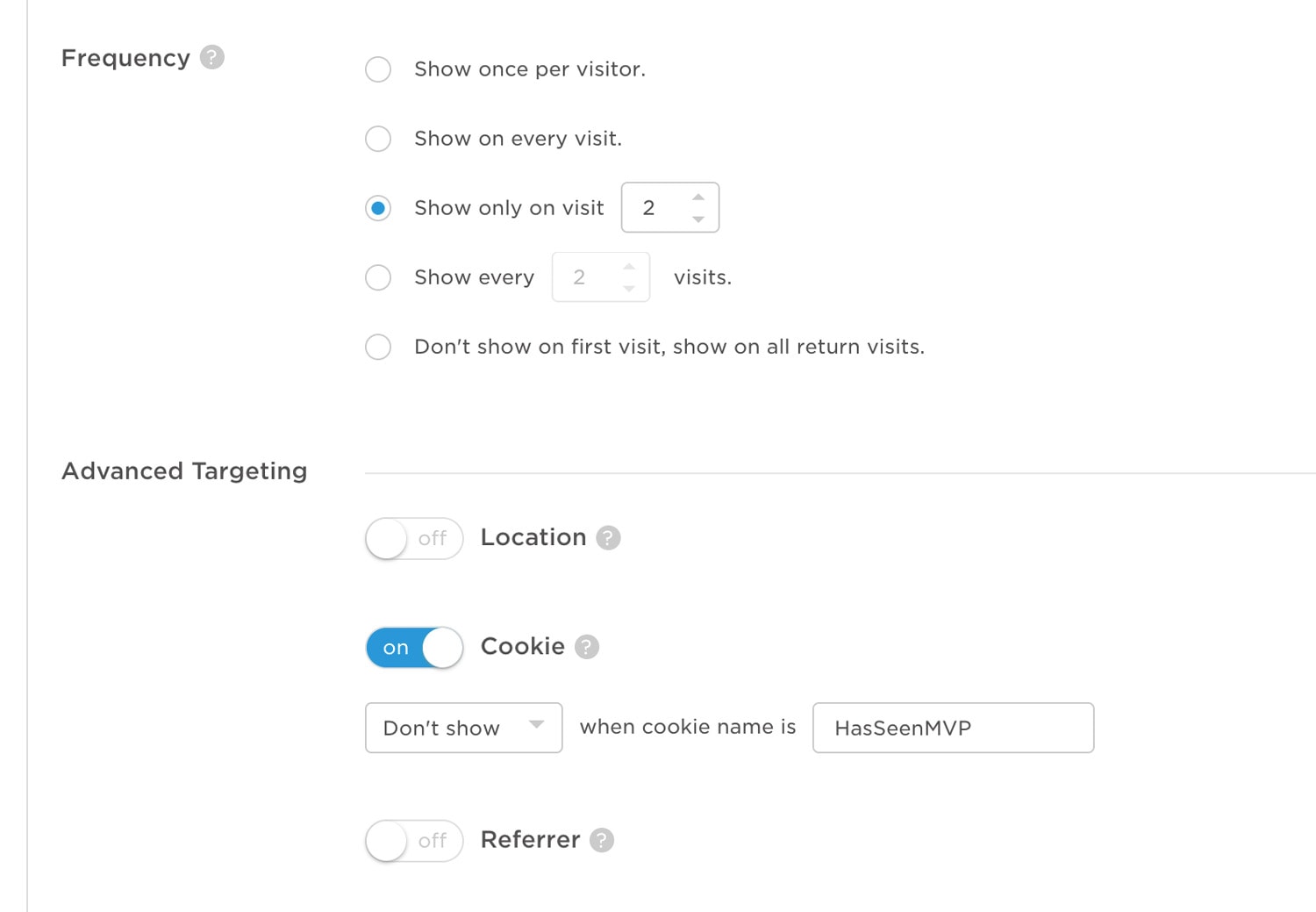
#9: Best Blog Content
In tomorrow’s final Product Awareness Month post, I’ll be sharing a lot of lessons I’ve learned over the past 30 days. One of those revolves around the topics of content that you’re writing about, and making sure they are things that people are A) interested in, and most importantly B) searching for.
To help you with this, you can use an exit popup to ask people which content they’d like to see more of. Then use this data (in combination with your SEO research) to guide your writing.
You can embed a simple Typeform in the popup to capture the responses.
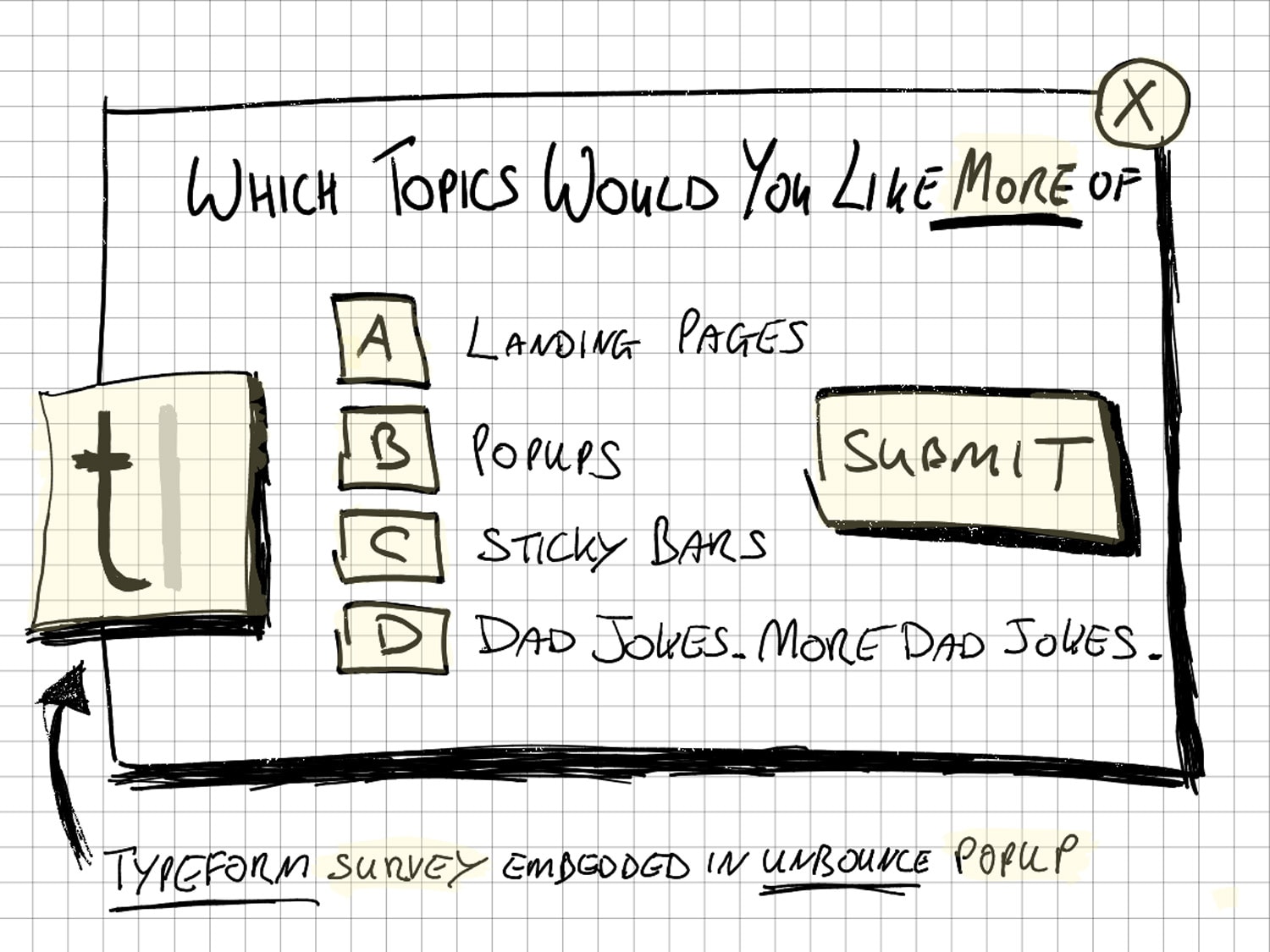
Note: to add a Typeform survey in Unbounce, simple paste the embed code (from Typeform) into a “Custom HTML” element that you drop onto your popup in the Unbounce builder.
#10: Product Awareness Clicker
If you want to collect data about the levels of product awareness you have, at the same time as increasing product awareness, this tip is for you.
While similar in terms of the question to the login hijack, your goal here is to target new visitors as opposed to existing customers.
Trigger a popup on your homepage or features page after a time delay, presenting a series of product/feature icons with the request: “Which products/features did you NOT know we provide?”.
To select the appropriate time delay, look at your analytics for the average time on page for the pages you’re targeting, and set it accordingly. You want to set it just below the average so people see it, but still have time to read your content.
You can measure the results with a click heatmap, or by embedding a Typeform survey in the popup like the previous example. I like Typeform because they have some beautiful and simple big-button layouts that are perfect for this concept.
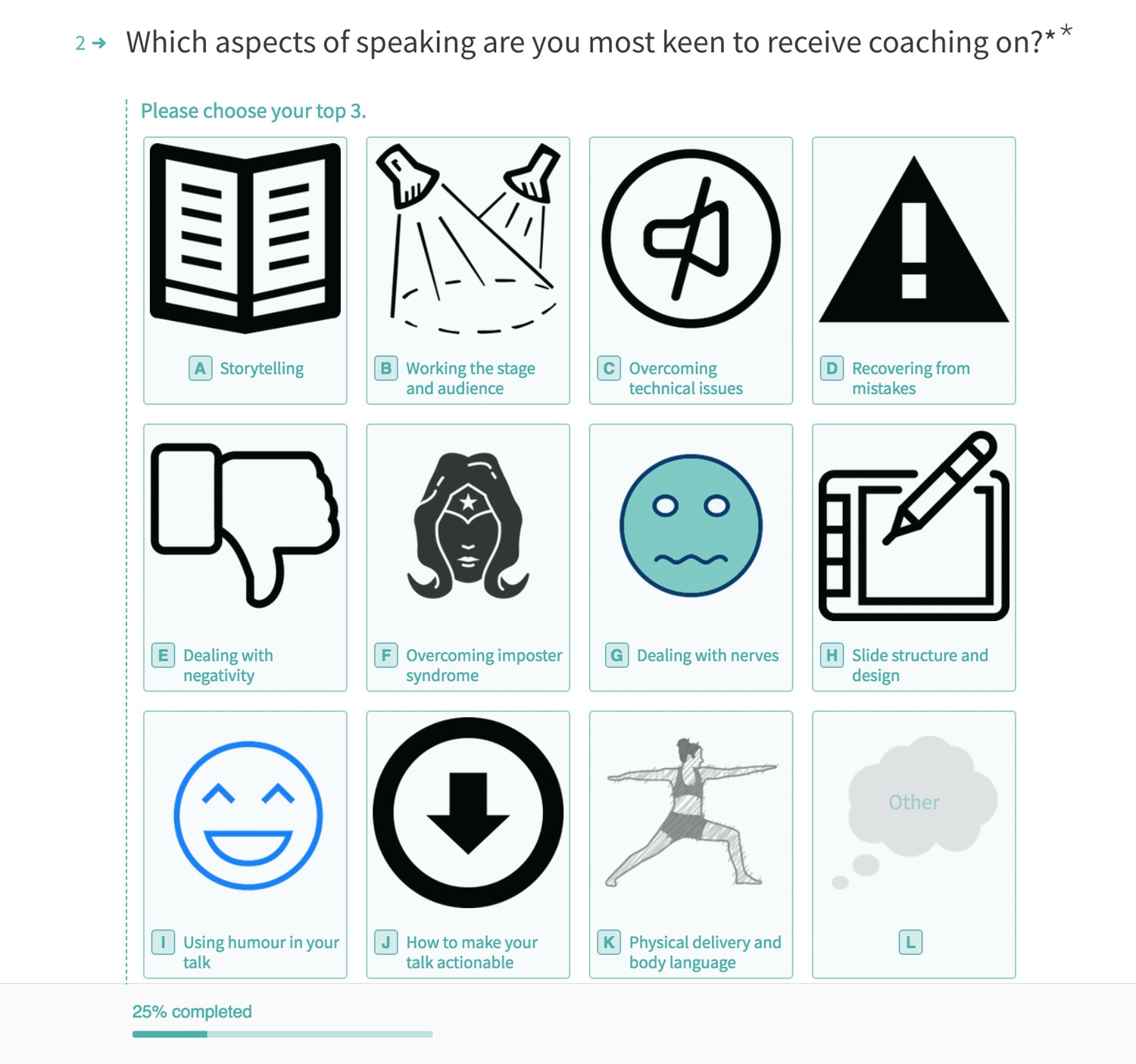
This is a good way to measure movement in your awareness metrics. For more clarity, segment customers from non-customers. You could do this with a second question on the Typeform survey that simple asks are you a customer. Or you could drop a customer cookie on your login or login success page and remove this cohort using the cookie targeting in Unbounce.
#11: Discount on 3rd exit
Just like shopping carts, pricing page abandonment is big deal, but you probably don’t want to give a discount the first time people leave, just because they’re leaving.
But if they repeatedly visit and leave your pricing page, it could be a signal that there’s an issue with them pulling the trigger. It might be the price point, and it might be worth experimenting with a discount using Popup or Sticky Bar.
You should be careful with discounts (if you’re a SaaS business) as they can affect your metrics in negative ways, but there is always a time and a place where it makes sense.
You can choose your own number, but I’d say that the third time someone visits and leaves your pricing page means it’s time to offer either a question (WTF dude?) or an offer/discount.
To do this with Unbounce, just use URL targeting for the pricing page, and show the popup on visit number 3.
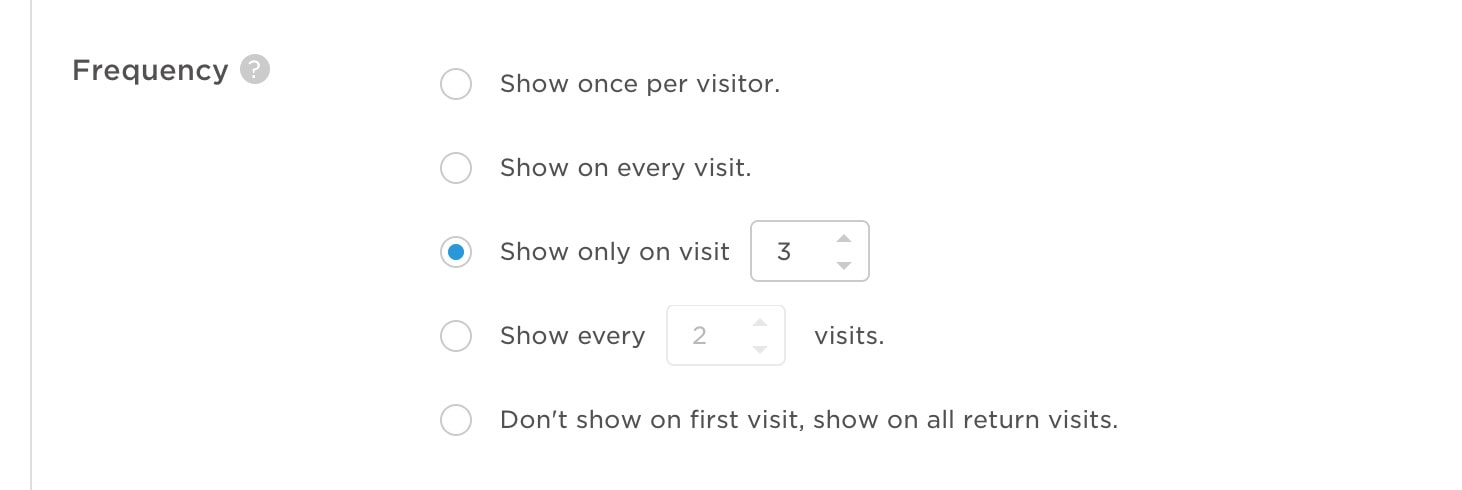
So there you have it. A whole bunch of ways you can get into website optimization without bugging your web developer (more than once).
Aaaaand now, tomorrow marks the end of my 30 posts (that became 20) in 30 days product awareness challenge. This will be a transparent deep dive into everything I’ve learned over the course of the month, data from conversions, leads, clicks, adoption, awareness, and every interaction I’m able to consolidate in the next 24 hours.
See you tomorrow. I promise some very interesting learnings and results.
Cheers
Oli Gardner
p.s. Don’t subscribe to “Product Awareness Month”, because it’s over. Instead you should just read the entie epic 20-post collection when you have time for some binge-reading.
Original Source: No-Touch CRO: 11 Ways to Optimize Your Website without Touching Your Website
Monday, January 29, 2018
Why Retention Emails Are Equally Important as Sales Emails
If you work in marketing or sales, you probably spend a lot of time thinking about using email marketing to acquire customers — watching engagement stats, A/B testing content, and planning campaign after campaign to convert.
What’s your best conversion rate on those campaigns? Ten percent? A little lower? Maybe a bit higher?
If there was a secret to converting your email campaigns at 30 percent or higher, would you want to know what it is? The answer is in your audience — and it’s a list you already have right in your CRM.
Here’s why you should be emailing your current customers just as much, if not more, than your prospects.
Why customer retention is important
Repeats beat first-timers
After making a purchase, a customer has a 27 percent chance of buying from you again. If they make a second and third purchase, they have a 54 percent chance of making another purchase.
These statistics showcase the importance of measuring customer lifetime value (CLV) — the projected revenue a customer will generate over their lifetime. Typically, the longer a customer sticks around, the more profit potential they have because the initial costs of conversion get smaller and smaller in comparison to spend.
However, in order to get the most out of CLV, you need to retain, upsell, and cross-sell your customers. In order do that in a world of increasing noise and competition, you have to stay top-of-mind. And email is still the top way in which most people would like to be reached.
When creating customer retention emails that keep you relevant, you have to remember it’s not about selling. It’s about providing value. Share information, tell a story, offer exclusives, brighten a day — when you show up with value in your customers’ inboxes, they’ll shop back up in your “checkout” line.
Referrals lower acquisitions costs
Each time a customer makes a purchase, they are becoming more comfortable with you and are therefore more willing to refer you onto someone else. After 10 purchases, customers refer 50 percent more people to a business than a one-time purchaser. Repeat customers can actually increase profitability not only by making more purchases but by attracting more clients through word of mouth. It’s nearly free marketing — the only cost is retention.
The key to retaining your customers in a way that encourages them to refer is to make them feel like they are part of your brand’s family. And families stay in touch. By emailing your customers with timely, relevant content on a regular basis you’re continuing to build your importance in their lives. You’ll make more sales and be the first product or service that comes to mind when a real-life friend or family member asks for a recommendation.
Customers are your best data points
If you want to learn how to convert your prospects, look no further than your current customers. That they’ve already taken the leap speaks to the fact that you did something right and through your long-term relationship you can get to know them better than you will ever know your leads.
Use your retention emails to gather data on your customers and build buyer personas and customer journeys that you can then use to inform your acquisition efforts.
7 retention email ideas to get you started
If you’re not sure where to start with customer retention campaigns, here are a few inspirational emails.
- Exclusives: A preview of a new product, a VIP-only event invitation, or a special sale all make customers feel “in” and valued.

- Requests: Being asked for our opinion triggers neurochemicals associated with satisfaction and empathy. Ask your customer for feedback to make them feel good and get valuable data.

- Gamification: Another trigger of happy neurochemicals are games – as the recent gamification software craze has shown for both employees and customers. Reward your customers for engaging with your brand and they’ll want to do more.

- Training: Continue to educate your customers on your product. The more they understand and gain value from your features, the longer they’ll stick around.

- Referral rewards: Happy customers are naturally great referrers, but that doesn’t mean they don’t benefit from an extra push.

- Just-for-fun: Your friends and family send you birthday and holiday greetings. Show up for special occasions in your customers’ inboxes. (This one from Southwest linked to fun videos.)

- Engagement reports: You’ll see “year in review” features on many social media tools like Facebook and Instagram, which are a good indicator that this type of information works for engagement. Celebrate your customer’s anniversary and don’t skimp on the details.

Curious about what other types of emails you could be sending? Check out this article and get inspired – 20+ Automated Emails You Should Be Sending Today.
If you spend as much time working on customer retention as you do on customer retention, you will be amazed at the results.
It is 5-10 times more expensive to acquire a new customer than it is to retain an existing one. By increasing your retention rate with email campaigns, you’ll see a better ROI from every single customer you sign up, more referrals, and better insights into growing your customer base.

![The Content Imperative for Successful Marketing Automation [Webinar Recap]](https://blog.getresponse.com/uploads/2017/05/content-imperative-min-315x158.png)
The post Why Retention Emails Are Equally Important as Sales Emails appeared first on GetResponse Blog - Online Marketing Tips.
Sunday, January 28, 2018
Saturday, January 27, 2018
Friday, January 26, 2018
Digital Marketing Certification: Take a Closer Look
The online world is constantly expanding. And that means there are virtually endless opportunities to reach new customers and grow your business. All you need to know is how to get your message across in the right way to the right people, and how to use the available technology, so you can best allocate your resources. GetResponse Digital Marketing Certification ticks all those boxes. Let’s take a look at how it works and its many benefits – so you can decide if it’s right for you or your marketing team.
What sparked the certification program?
We’ve been in the online marketing game for almost 20 years – long before content marketing was even conceptualized. We’ve watched email marketing go from new kid on the block to an essential tool, and we’ve seen social media change the way we interact with brands and with each other.
As new technologies emerge, we often hear “email is dead”. But based on our experience and evidence, we know email is here to stay. The future will simply be about integrating the right tools into an online ecosystem, so you can swiftly and seamlessly reach your business goals.
But when you’re just starting out, how do you know which tools to use? The amount of information online can be overwhelming. So it’s common to overthink things, and then battle through with trial and error. You might also choose the wrong technology – or use it in the wrong way. And that’s a recipe for lackluster marketing results.
That’s why we created the GetResponse Digital Marketing Certification program: to fast track your path to becoming an online marketing expert.
Who will teach you?
So far, we have 14 world-renowned digital marketing experts on board. You’ll learn from industry leaders like Andrew Davis, Kath Pay, Michael Brenner, and Jamie Turner. Our GetResponse teachers will also share their in-depth insights in the shortest time possible – so you can put your new skills to the test right away.
What’s inside the program?
Let me now walk you through all the course content, so you can choose the certification you need most. Right now, there are four courses on offer. After completing an end-of-course exam, you’ll get an industry-recognized certificate to showcase your expertise.
Email Marketing
In this course, you’ll discover how to create an effective email marketing strategy with list building, copywriting, email personalization, A/B testing, deliverability, and other essential best practices.
- Module 1: Introduction to email marketing
- Module 2: List building and management
- Module 3: Creating effective emails
- Module 4: Deliverability and compliance
- Module 5: Advanced email marketing
Marketing Automation
You’ll learn how to create a winning marketing automation strategy. Our experts will show you case studies and best practices for segmentation, tagging and scoring, e-commerce integrations and more.
- Module 1: Introduction to marketing automation
- Module 2: Marketing automation strategy
- Module 3: Use cases
- Module 4: E-commerce
- Module 5: Advanced topics
Landing Page and Conversion Optimization
This course walks you through creating an effective landing page optimization and conversion strategy. Our experts will demonstrate case studies and best practices in design, traffic generation, copywriting, and testing.
- Module 1: Introduction to landing pages
- Module 2: Landing page content & design
- Module 3: Analytics and basic traffic sources
- Module 4: Optimization
- Module 5: Advanced topics
Content Marketing
In this course, you’ll discover how to create an effective content marketing strategy with blogs, webinars, video marketing, and social media tools.
- Module 1: Introducing content marketing
- Module 2: Blogging
- Module 3: Webinars
- Module 4: Content marketing in action
- Module 5: Advanced topics
How else can you benefit?
The Digital Marketing Certification Program doesn’t just equip you with fresh skills and knowledge. With an industry-recognized certificate, you’ll also be seen as an online marketing professional.
You can publish posts on our blog and share your expertise with thousands of visitors. And by joining our Facebook group, you can network with industry experts, influencers, and our thriving community.
It’s also possible to promote your work to tens of thousands of people in the GetResponse Marketplace – and find new customers looking for a certified expert.
You also get 50% off ResponseCon tickets. As a certified partner, you can even join us on stage and share your story with a captive audience.
Get certified
Now you know what to expect, visit the GetResponse Digital Marketing Certification Program and enroll. See you there!


The post Digital Marketing Certification: Take a Closer Look appeared first on GetResponse Blog - Online Marketing Tips.
5 Mind-blowing Use Cases for Website Popups You’ve Never Considered (Includes Augmented Reality)
Okay, so perhaps only one of these use cases will blow your mind, but it’s worth risking being labeled as click-bait to get this in your hands. Read on for the coolest things you can do with website popups. Ever. Including augmented reality. Yup.
Example #1: The Augmented Reality Customer Postcard
Alright, people. Prepare to have your minds blown. This example comes from one of our designers, and chief hackers, at Unbounce, Luis Francisco.
Imagine the image below is a postcard you sent to your customers.
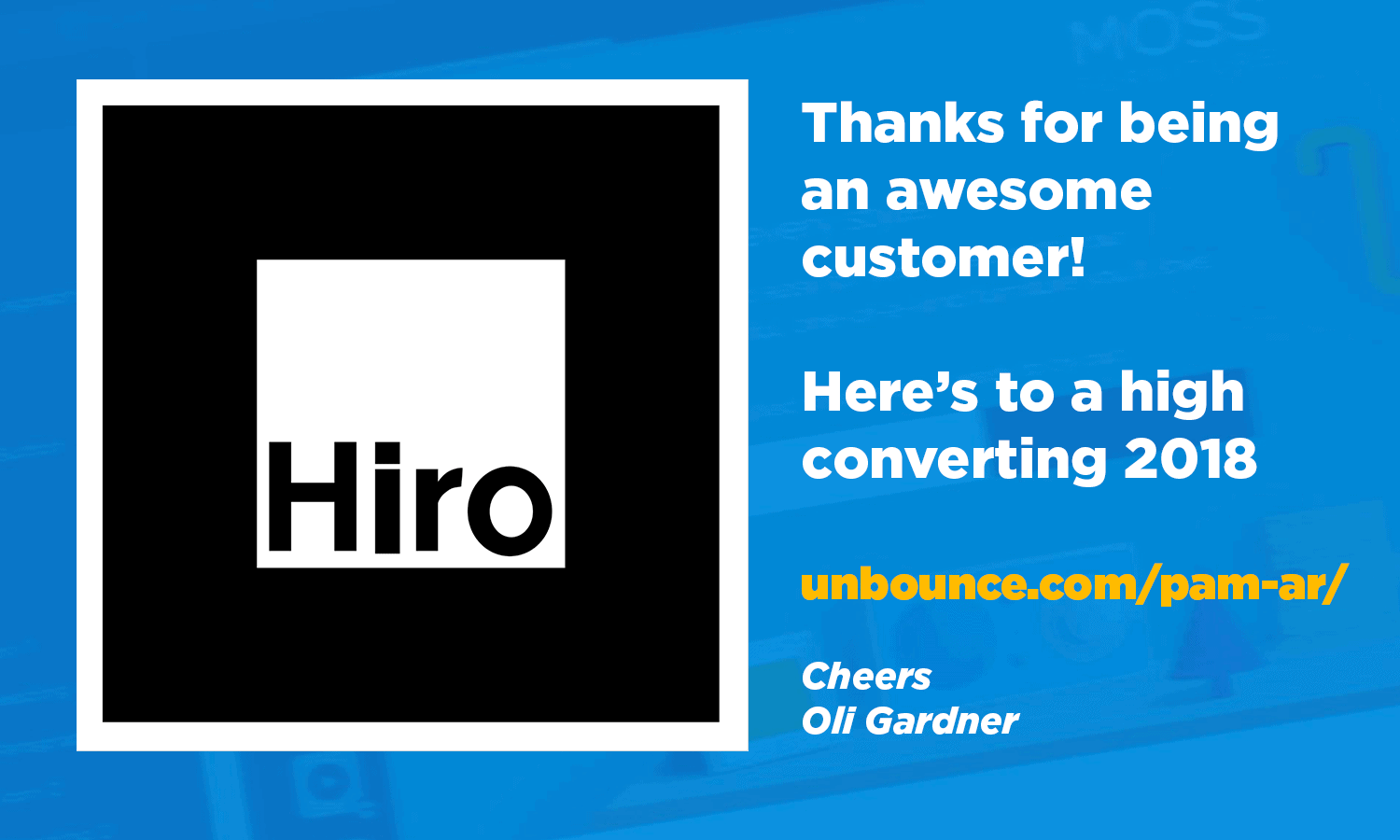
They visit the URL printed on it, and then this happens!
Watch me blow my own mind
Try it yourself
Note: This demo uses your laptop’s camera (it won’t work without one). Follow these instructions to see how it works!
- Print out the postcard image (opens in new tab)
- Open this landing page (opens in new tab)
- Grant access to your camera when asked by the browser.
- Hold the postcard in front of your camera to see the magic! (Stand a few feet back).
Example #2: The Website Login Hijack
35% of all visitors to Unbounce.com are only there to log in to the app. You read that correctly. Thirty-five percent. You can see the details in this GA screenshot from the month of January 2018.
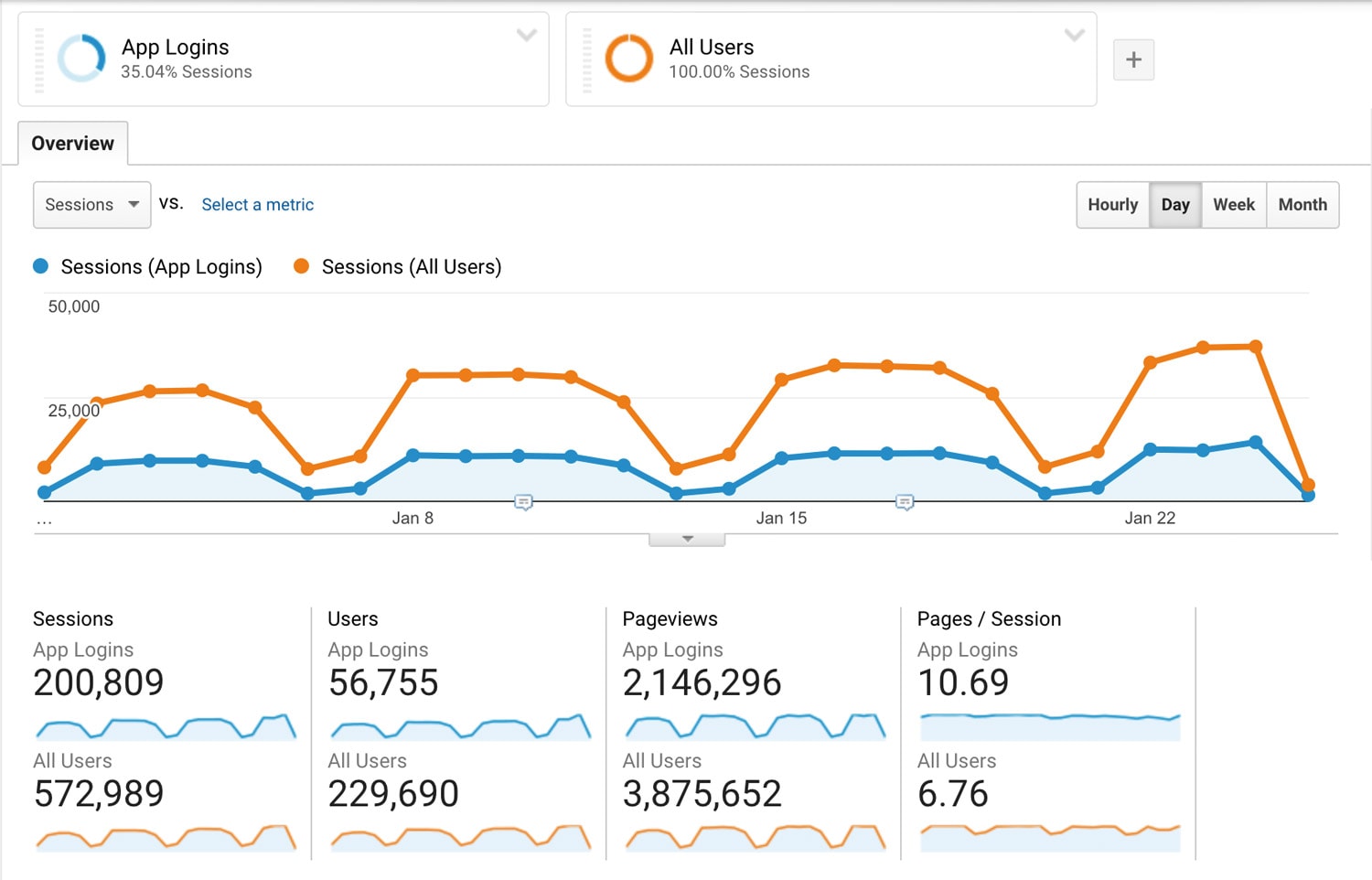
This is an incredibly common thing for SaaS businesses, where customers will visit the homepage to click the login link. You’ll want to create a segment in Google Analytics for this, so you can remove it from your non-customer website behavior analysis.
It’s a huge opportunity for product marketing.
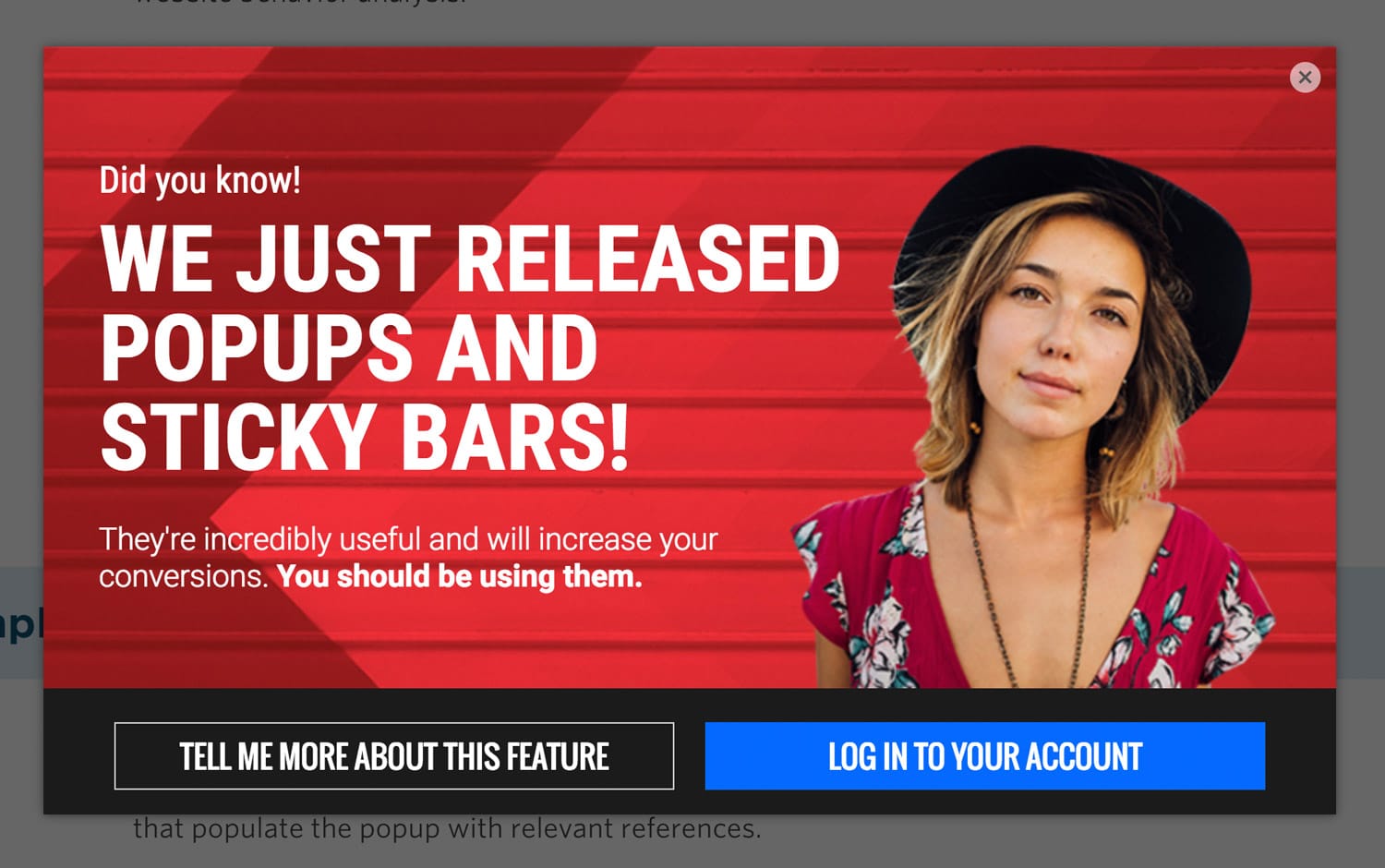
If you drop a cookie on your login screen that identifies the visitor as someone trying to log in, you can then use the cookie targeting built into Unbounce to target returning account holders with a website popup containing new product release info, along with a large login link that makes their experience even easier.
Click here or the image below to see an example popup.
Example #3: Social Referral Welcome
Are you doing as much as you can to convert your visitors from social? Probably not, but that’s okay. For this idea you can add an extra level of personalization by detecting the referring site (an Unbounce popup feature) and present a welcome experience relevant to that source.
You can take it a step further and have custom URL parameters on the social link that populate the popup with relevant content.
This is made possible by the Dynamic Text Replacement feature in Unbounce.
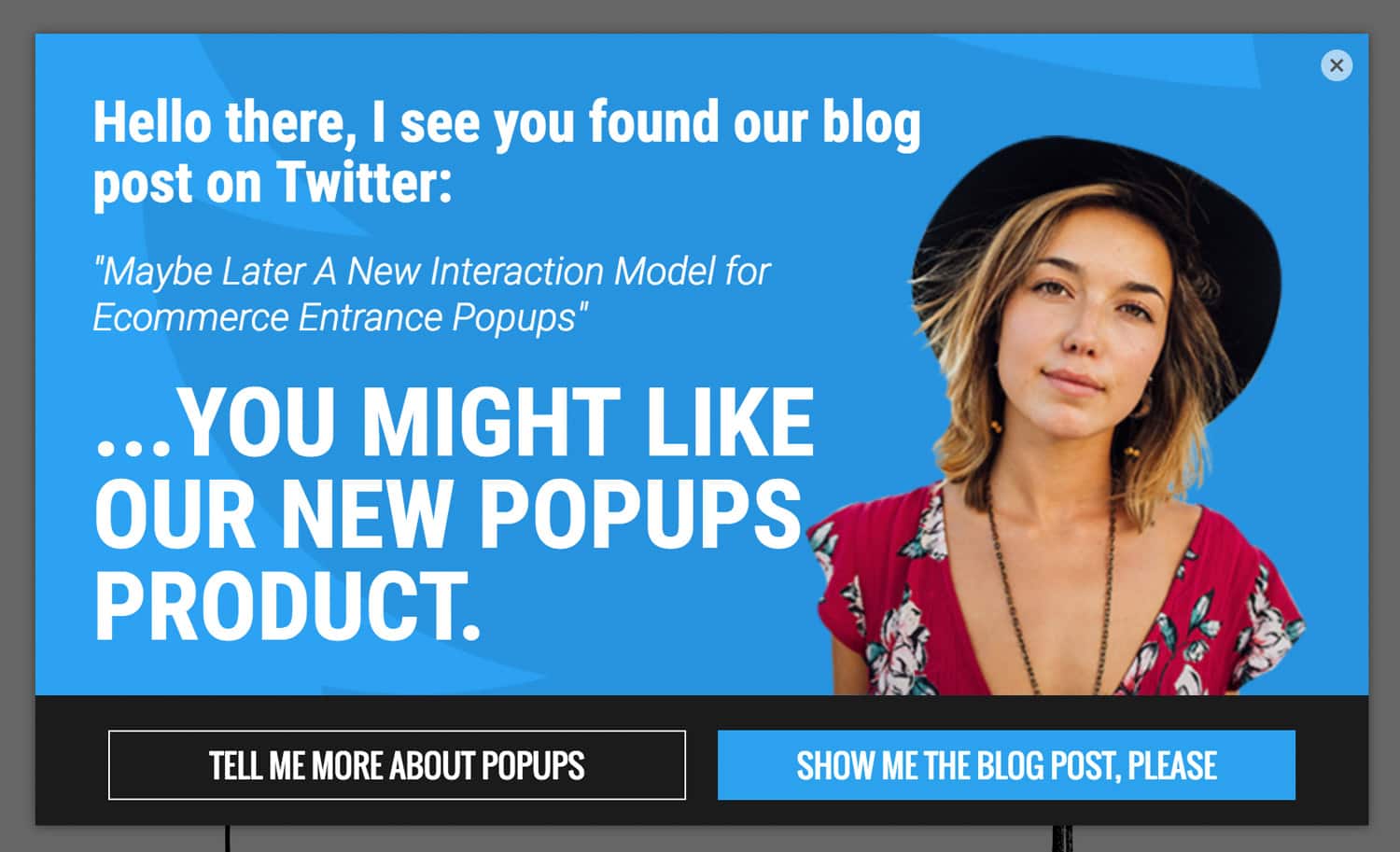
Check out the Tweet below. When I shared the blog post on Twitter, I added a URL parameter to the end of the URL so it reads:
https://postURL/?postTitle=“Maybe Later” - A New Interaction Model for E-commerce Entrance Popups
“Maybe Later” – A New Interaction Model for Ecommerce Entrance Popups >>https://t.co/ZoxZOvYFY4
— Oli Gardner (@oligardner) January 26, 2018
Try clicking the link in the Tweet. It will take you to our blog, and will show you a popup that’s only triggered when the referrer is Twitter (specifically a URL that contains t.co which is the Twitter URL shortener).

This is a really powerful way of connecting two previously disparate experiences, extending the information scent from one site to another. All without writing a single line of code.
Example #4: Preferred Social Network Share Request
If someone comes to you from twitter it’s a strong signal that Twitter is a social network of choice – or at least somewhere where they look for and respond to, socially shared content. As such you can give them a customized tweet ready for that network when they’ve demonstrated some engagement with your blog.
Using the referrer URL targeting option in Unbounce you can easily detect a visit from Twitter, Facebook, LinkedIn etc. Which is what I showed you in the previous example.
You can use different triggers for this concept that are likely to be more indicative of someone who’s engaged with the post. I’d suggest the scroll trigger (either up or down), time delay, or exit.
The reason I like this approach is that most people have a preferred social network. Mine is Twitter. If you give me a specific task, such as “Would you share this on Twitter for me, please?” with a Tweet button and prepared Tweet text, I’m more likely to engage versus having 5 social share buttons at the side or bottom of the post with no instructions.
Click here or the image below to see this concept in a popup.
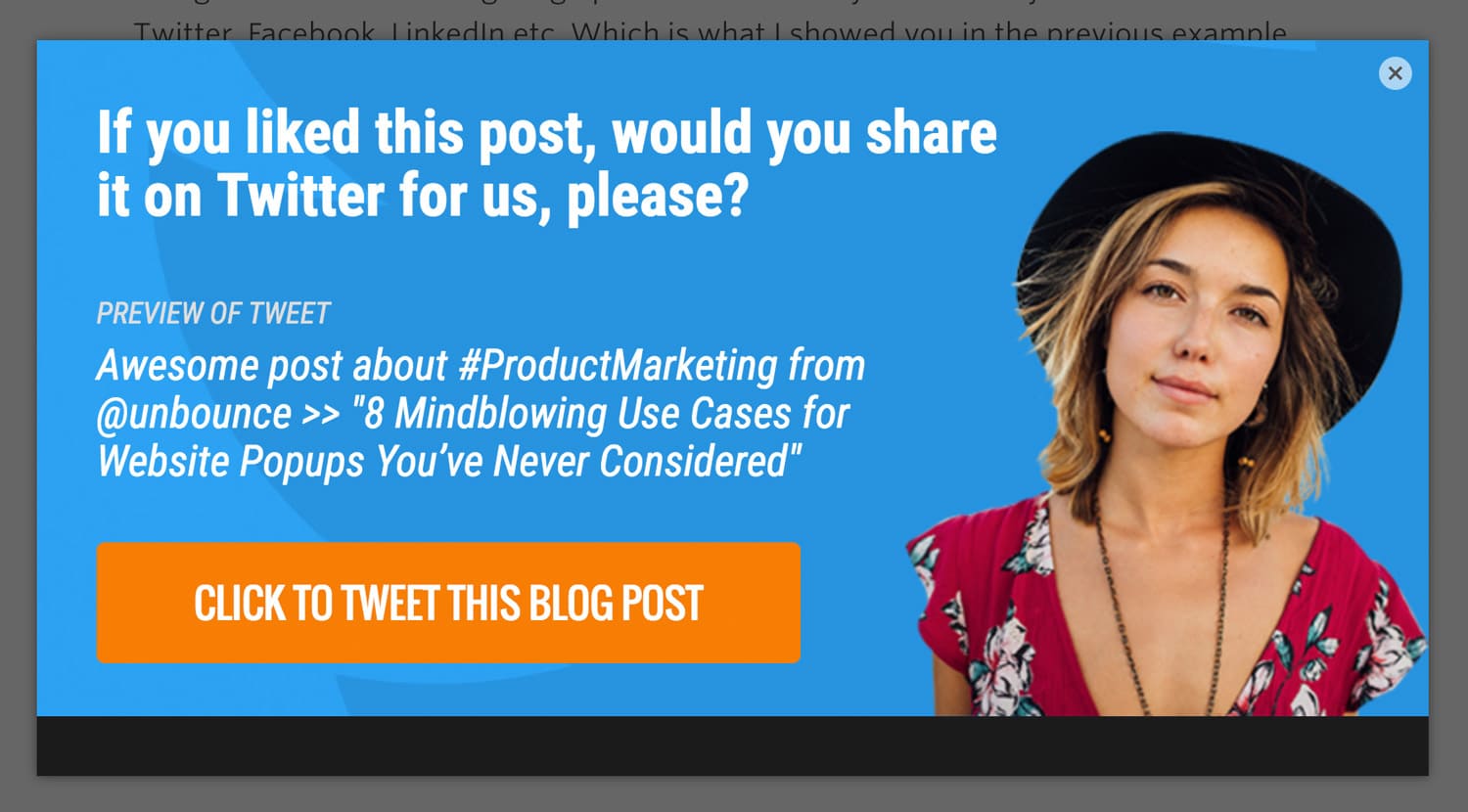
You’d then craft a really good Tweet, with text or links specific to this tactic so you can measure its impact.
BTW: the button in that popup is functional and will actually Tweet about this blog post. I’d really love a share from you, just so you know. Show the popup again so you can Tweet it.
Example #5: Joke of the Day
Let’s end the post with a fun one. I’m sure you’ve all seen those messages or jokes that appear on Slack as it’s loading (it’s a thing). It can be fun to have that unusable time filled with something delightful.
Well, this is kinda like that, except that it’s not appearing during a loading sequence, it’s just straight up thrown in the face of your visitors. Because we need to experiment, people!!!!!!!!!
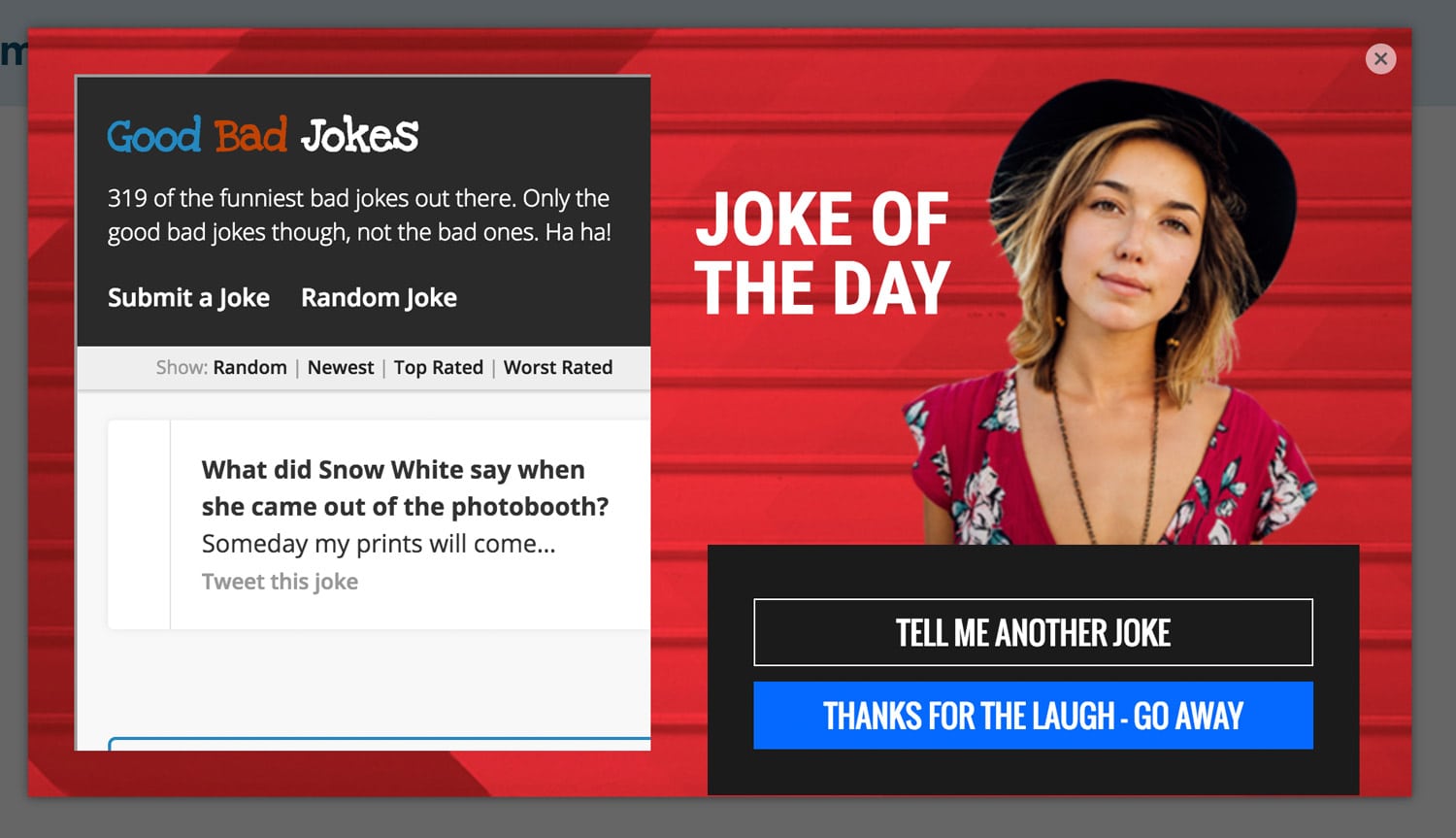
For bonus points, only show this to folks who have the cookie set in example #2 – “The Website Login Hijack” cos they’re customers and might appreciate it.
To do this, I took Unbounce co-founder and Chief Product Officer, Carter Gilchrist’s pet project “Good Bad Jokes” and embedded a random joke into an iframe in a popup. Boom!
Fair warning, some of these jokes are a little NSFW.
Click here for your Joke Of The Day.
Now go back to the top and try the augmented reality example again, and then share it on your preferred social network because it’s awesome, and that’s an awesome way to do business!
Cheers my dears,
Oli
Original Source: 5 Mind-blowing Use Cases for Website Popups You’ve Never Considered (Includes Augmented Reality)
Thursday, January 25, 2018
Changing On-Page Behavior with Sticky Navigation and Data-Driven Design
As an optimizer, there’s nothing that excites me more than using design to change on-page behavior. By “change”, I mean to positively influence visitors to achieve their (and your) goals more effectively, and sticky navigation is a great way to increase your odds of driving behavioral change.
The best way I know to design experiences that change on-page behavior is to use my Data-Driven Design (3D) framework to gather and observe available data, and use the Micro Metrics Method (3M) to guide design exploration.
This is what I’ll be showing you today by using sticky navigation on a long landing page and also on this blog post.
It’ll help you move around the content while secretly showing you the cool things you can do with Unbounce ;)
What is Data-Driven Design? (3D)
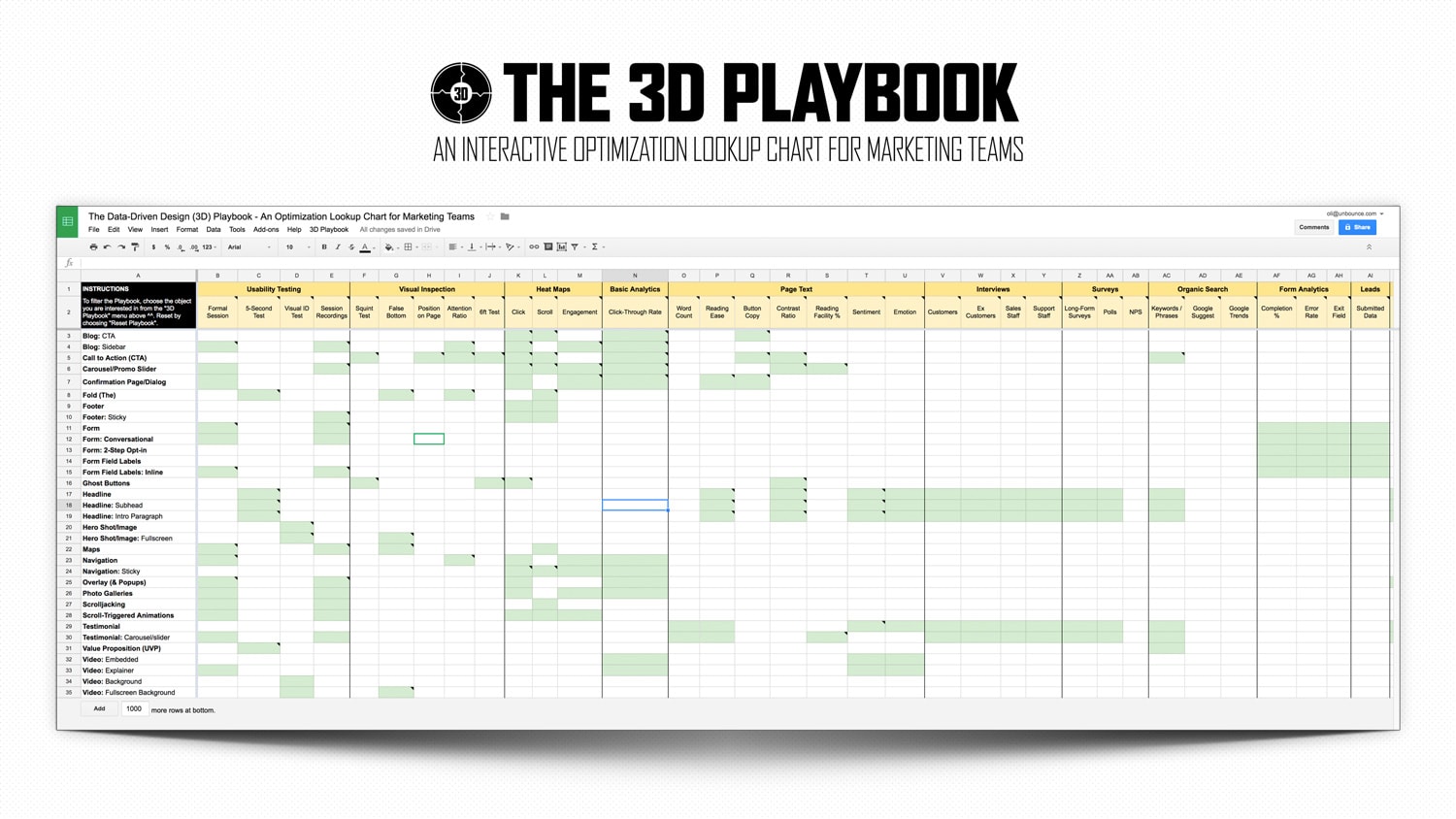
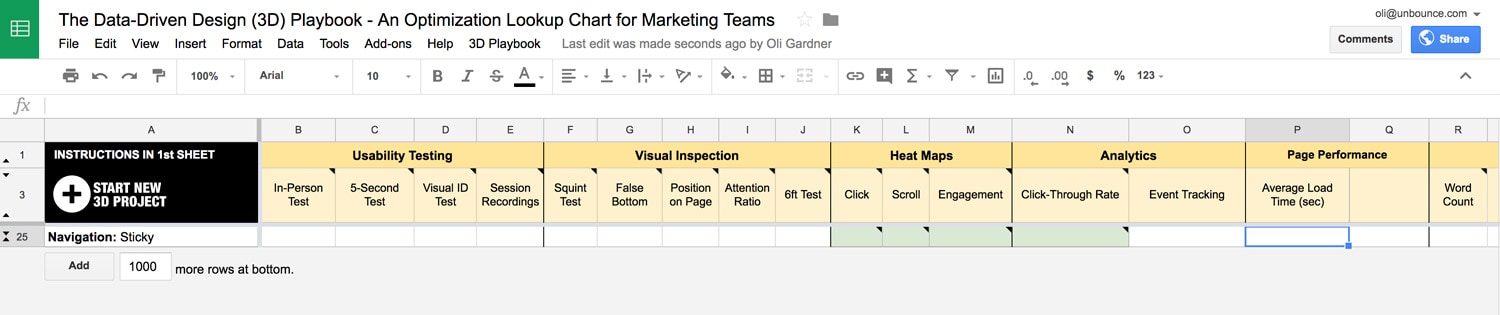
Data-Driven Design is an 8-step collaborative optimization process designed to help your marketing team work together to increase conversions, but more importantly, to develop empathy for your customers and your coworkers. It begins with The 3D Playbook, which is an interactive lookup table that helps narrow down the data types you should be looking at when trying to optimize your landing pages, websites, and more.
It looks like the screenshot below, and you can check it out at this link. The process for using it needs more explanation that I can give in this post, but I am doing a webinar at Marketing Optimization Week where I’ll cover it in depth.
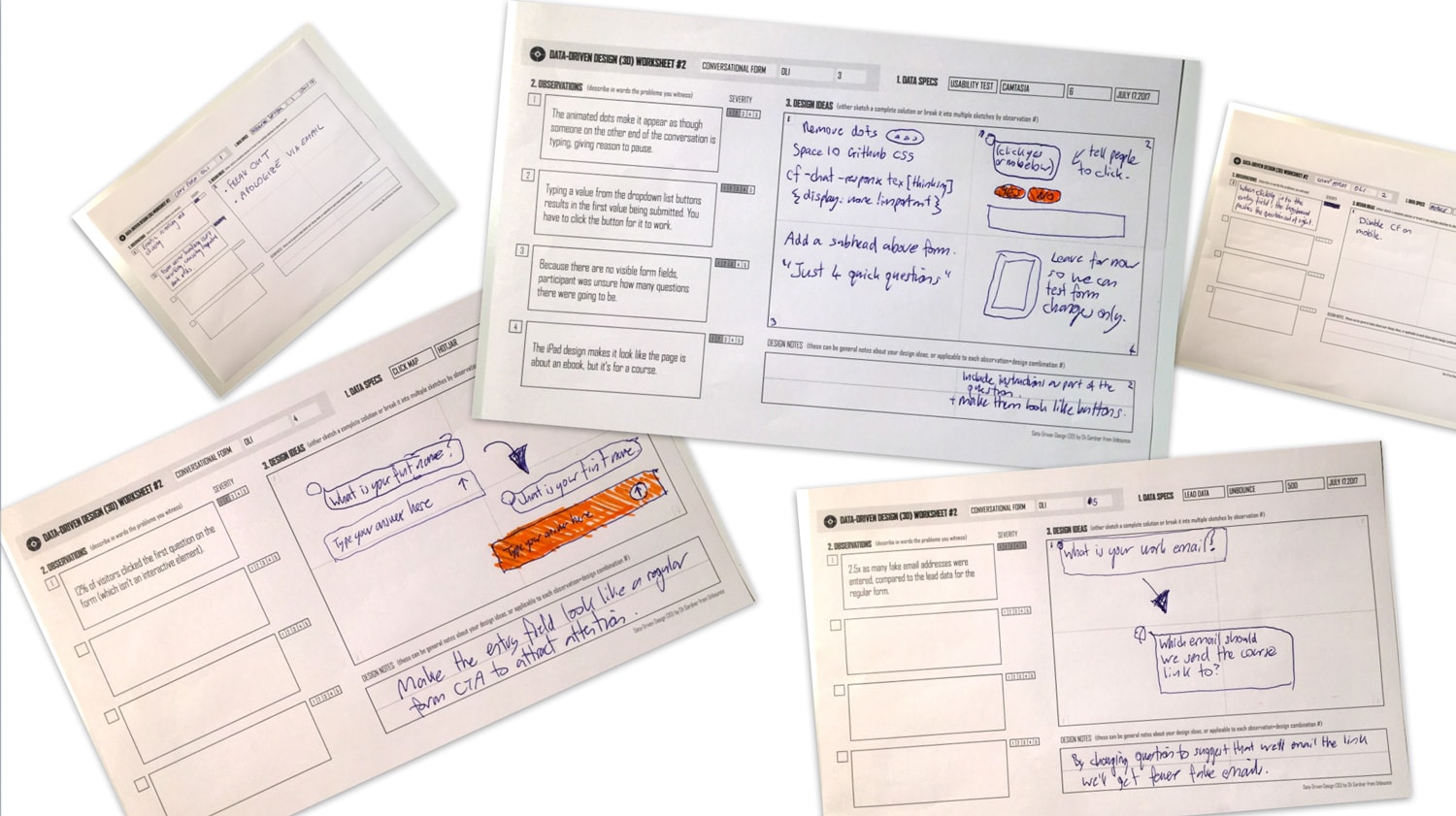
One of the most important steps in the process is taking the observations we make looking at data (analytics, heatmaps, usability tests etc.), and working as a team to design solutions to each of the problems you observe. Measuring the impact that these design changes have is called the Micro Metric Method (3M).
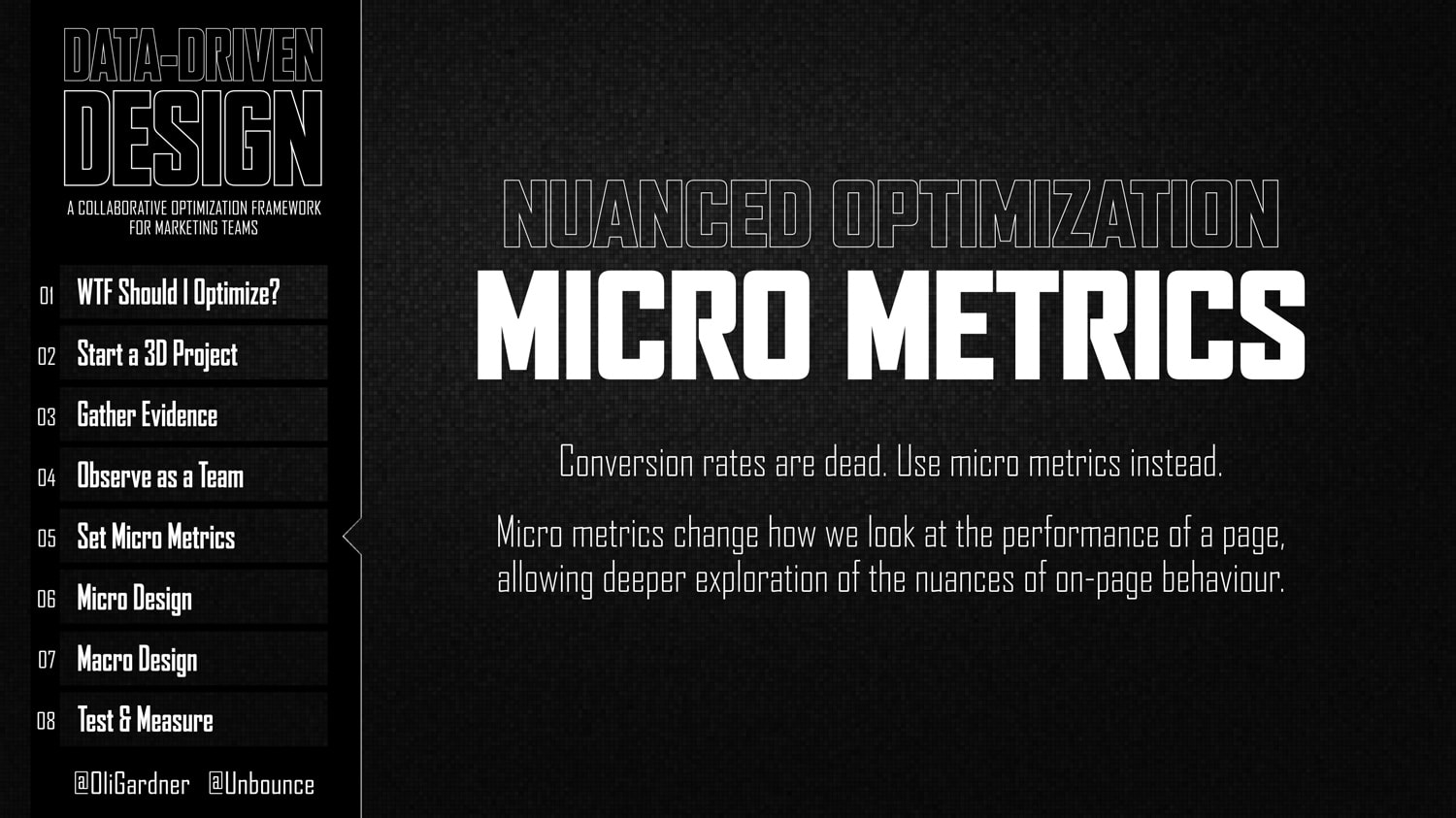
What is the Micro Metrics Method? (3M)
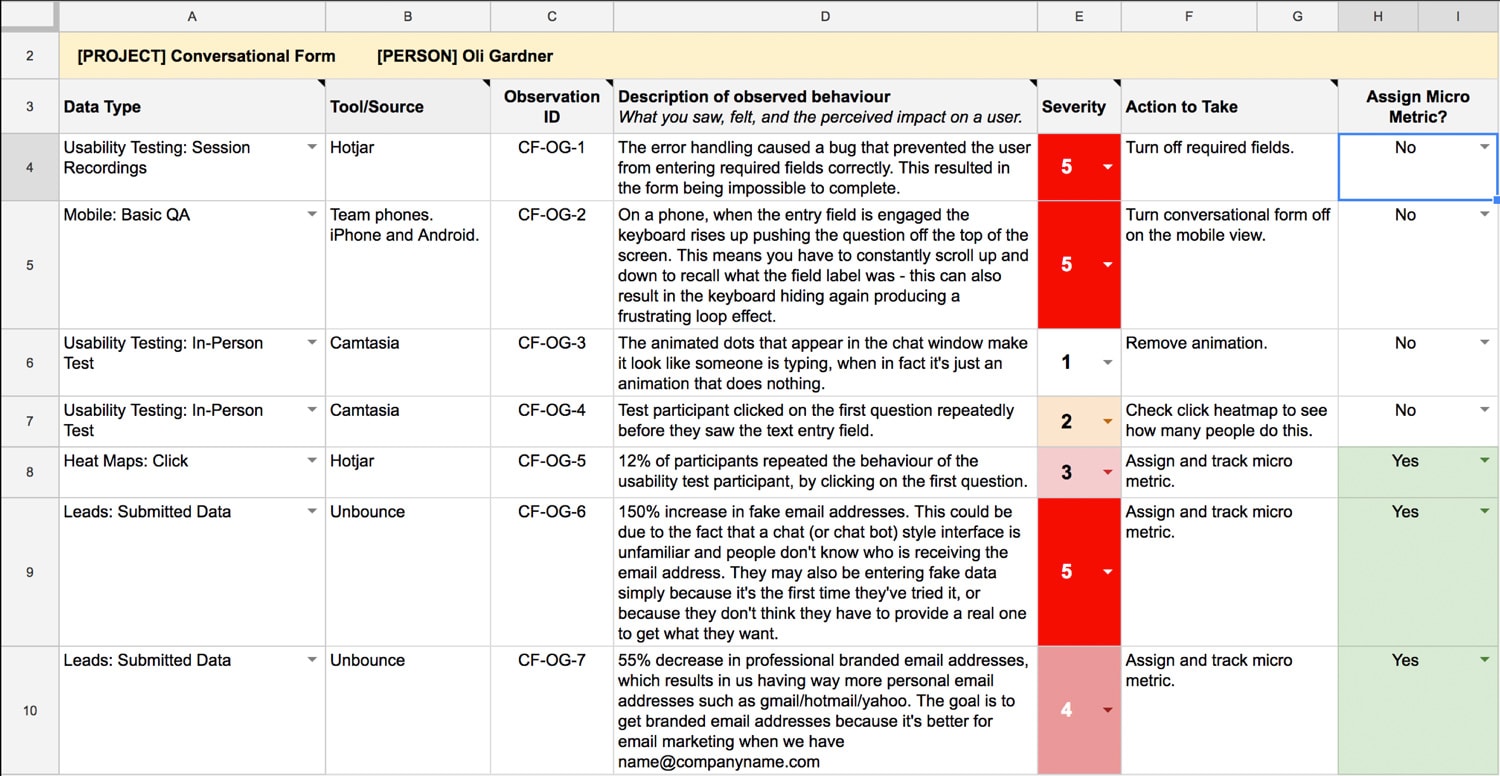
When you make observations as a team (I recommend you include a designer, copywriter, and marketer), not only are the solutions better, but the collaborative nature helps with team/client/executive buy-in for the changes you’ll propose. You can see a session I ran recently below. We watched usability test videos and took notes about the observations we were making in a shared doc that is created for you as part of the 3D Playbook (when you choose a page element from the menu it will create a series of worksheets for you and your team – the instructions on the first page of the sheet explain how).
A marketing team following the Data-Driven Design process

A definition of micro metrics
A completed worksheet with observations, severity ratings, and those assigned as micro metrics
The design solution sketches the team came up with to solve the problems identified by the micro metrics
Watch Me Give the Data-Driven-Design Talk Feb 23rd
I’m actually giving my Data-Driven Design for Marketing Teams talk for Marketing Optimization Week, so you should definitely register for that and I’ll run you through the whole process. MOW is a 4-day event from Feb 20-23 and I’m on the last day.
How to Use Sticky Navigation to Change On-Page Behavior
I’ve set up a demo page that shows a long landing page with a sticky nav that I created using an Unbounce Sticky Bar with some CSS to hide the close button. The goal of sticky navigation is to increase the level of engagement with your page by presenting persistent options that explain what’s available on the page.
I really love this approach to landing page design, where it’s standard – and recommended – to not have navigation (that takes you away from the page). In particular, it’s great because it’s persistent. It scrolls with you so the opportunity for behaviorally interesting clicks doesn’t go away. What I mean by that is that there’s so much more data to collect when the navigation follows you down the page. When it’s fixed to the top of the page, you have very few opportunities beyond the very first click, to get a sense of which items trigger intent.
According to The 3D Playbook, for sticky navigation, we should first look at heatmap data and the click-through rate of each navigation link, as well as the primary call to action you have on your page.
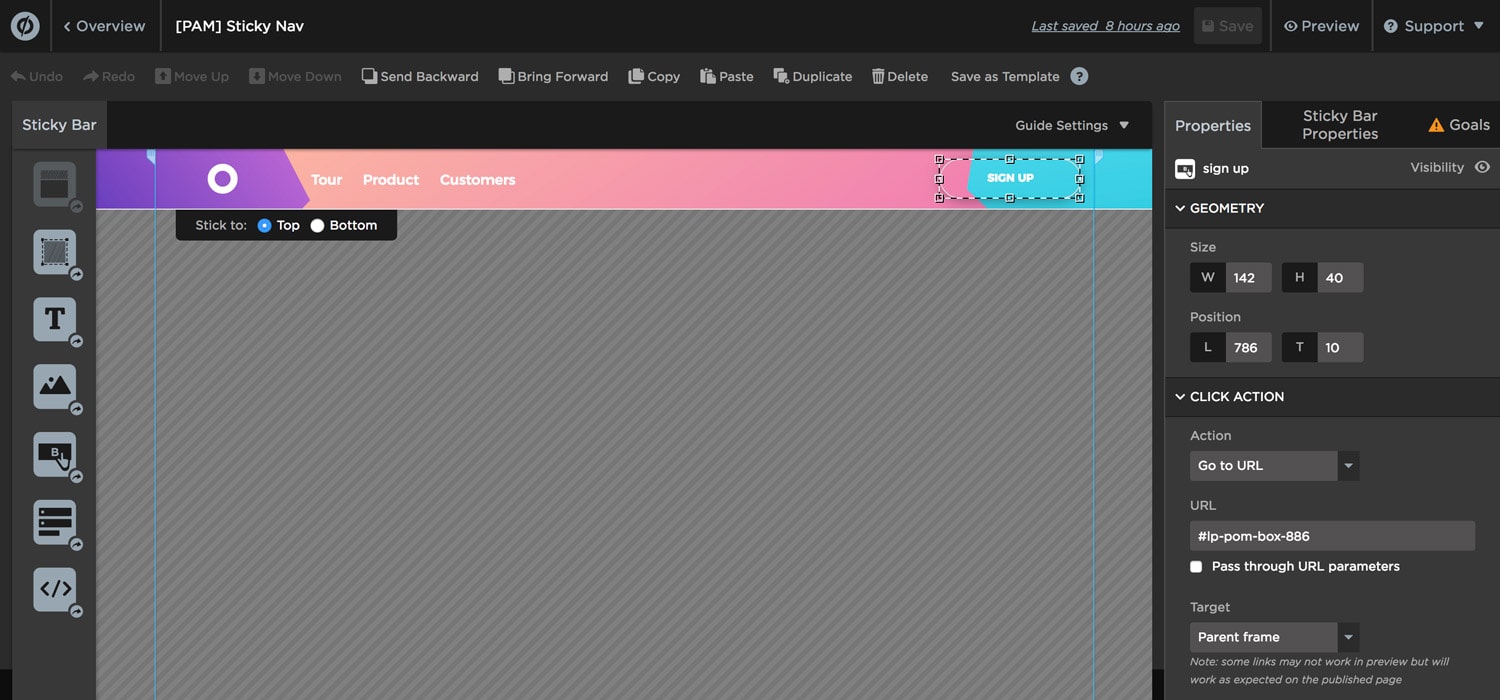
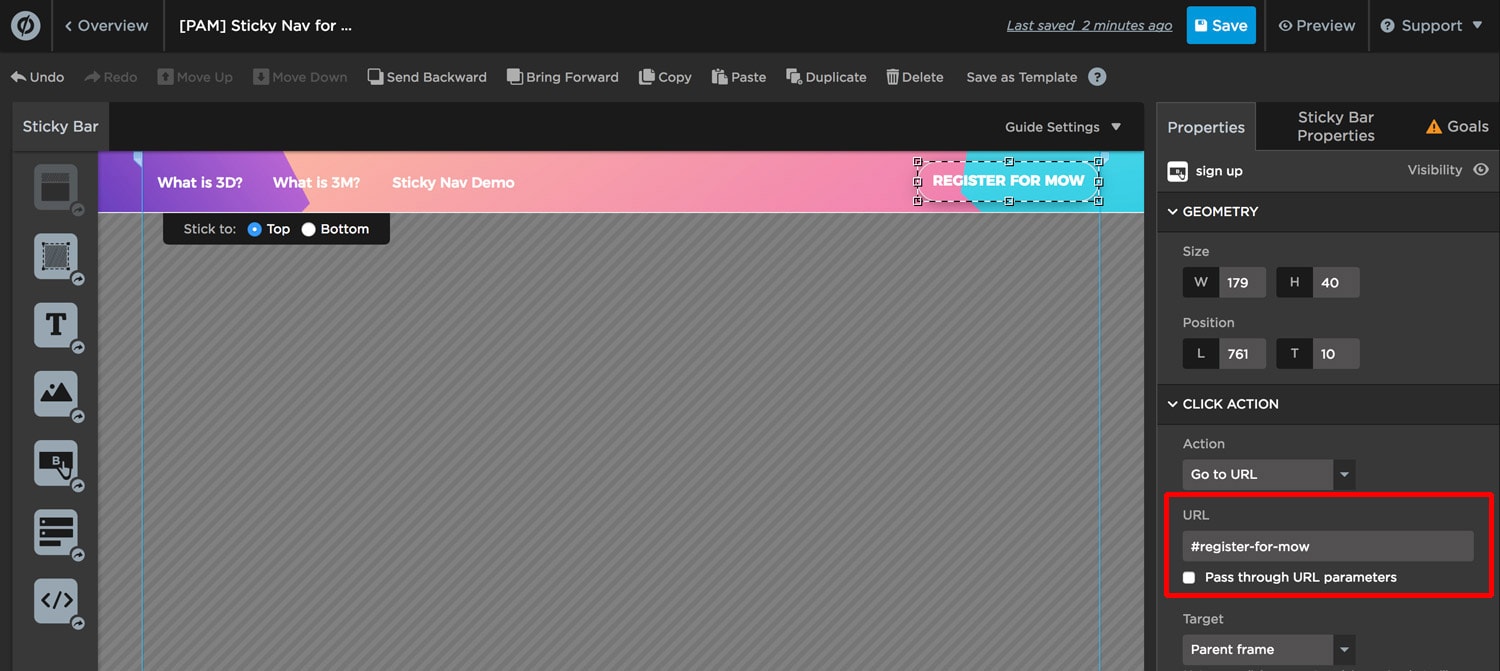
In the Unbounce app, I used a sticky bar to create a navigation bar, assigning each link to the ID of a page element on the landing page that it would reside on.
Below is a screenshot of the sticky nav that shows up on every post of Product Awareness Month (except this one and one other where I’m demoing sticky bars). I’ll be sharing the data I collected from this, and a gazillion other data sources, in the end of month results show.

Sticky nav helps increase engagement with your content, bringing people further down the page to sections they may otherwise not see, and almost as importantly, it lets you measure what people ate interested in.
DEMO: How to Use Sticky Navigation to Increase Blog Engagement
You can click here to show a sticky nav on this blog post. I’ve set it up so that the nav links connect to different “chapters” of the post. It’s a great way to direct your readers, and also to gather valuable engagement data by looking at click heatmaps and analytics.
It’s very easy in Unbounce to duplicate a Sticky Bar and apply it to another page! Huzzah! Product awareness in action. Remember to click here to show the sticky nav.
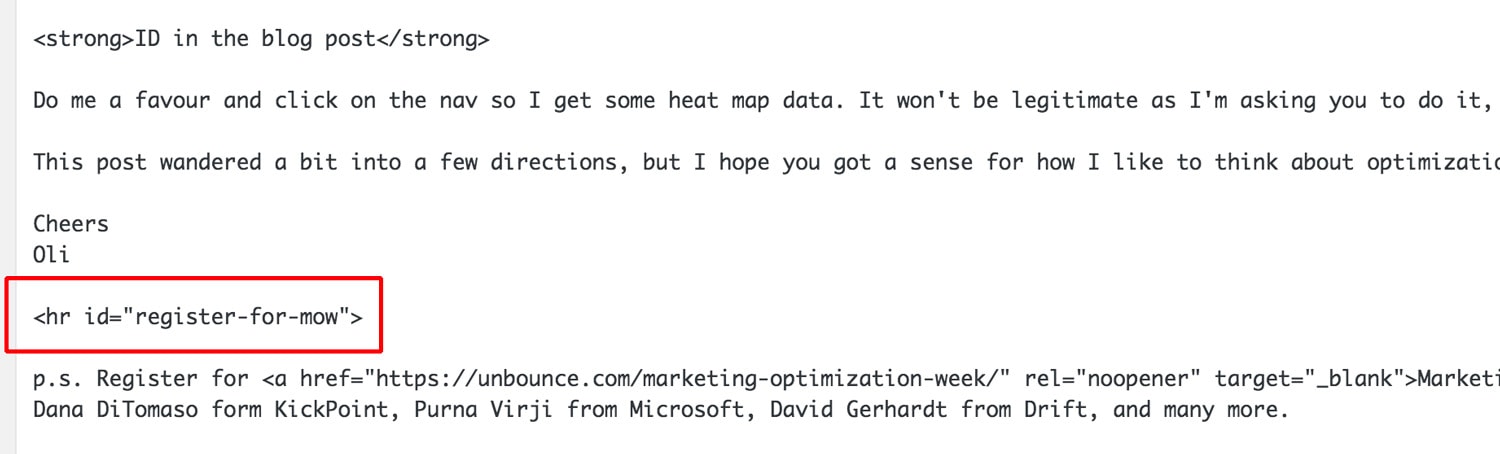
Notice the CSS ID shown for the click target in the screenshot below (it says URL: “#register-for-mow”). This makes the nav link jump to the corresponding section of the blog post that I set up by adding an ID to a page element.
Sticky Nav in Unbounce: links to #register-for-mow
#register-for-mow as a target ID in the blog post
Do me a favour and click on the nav so I get some heat map data. It won’t be legitimate as I’m asking you to do it, but hey, shits and giggles amiright?
This post wandered a bit into a few directions, but I hope you got a sense for how I like to think about optimization, why sticky nav is awesome, and why we need more collaborative frameworks like Data-Driven Design.
Cheers
Oli
p.s. Register for Marketing Optimization Week to see 4 days of the most badass content including my Data-Driven Design framework, plus Larry Kim from Mobile Monkey, Dana DiTomaso form KickPoint, Purna Virji from Microsoft, David Gerhardt from Drift, and many more.
Original Source: Changing On-Page Behavior with Sticky Navigation and Data-Driven Design